

While Legal Scholars Seek to Promote and Reinforce International Humanitarian Law, Their Subjectivity and Political Agendas Now Undermine It

The Abrupt Announcement of a Two-Week Ceasefire in the War Between the U.S., Israel, and Iran Resolves None of the Issues Which Caused the Conflict

Group that Affirmed Hamas’s October 7 Attack Defends Terrorists in India

His Clerical Rank Did Not Qualify Mojtaba to Be Supreme Leader, but the Islamic Revolutionary Guard Corps Did Not Care

The Tactical Triumph and Strategic Uncertainty of Operation Epic Fury

The Iranian News Media Have Not Fully Reported the Reverberation of the War on the Iranian Economy

Experts Warn of Radicalization Persisting at ‘Precariously High Levels’

Vatican Maintains Formal Ties with Top Iranian University Despite Theocratic Regime’s Massacre of Thousands

The Emirates Remains a Stabilizing Actor with Strong Ties to Israel, the United States, and Other Key Regional Players

While Oversight Stalls, Tehran-Aligned Networks Continue to Operate in Plain Sight

Explosive Claims Point to Coordinated Pressure Campaign Targeting Wealthy Individuals

When Authoritarian Systems Feel the Pressure of Accumulated Illegitimacy, They Announce Elections

The U.S. And Israel Should Target the Islamic Republic of Iran’s Core Pillar of Repression: The Judiciary

Assad’s Fall Has Stripped Iran of Most of Its Assets in Syria, but Networks Remain and Could Be Leveraged to Open a New Front

The Administration’s Proposed Agreement Would Curtail Tehran’s Ability to Develop a Nuclear Weapon, But Would Not Touch the Real Drivers of Iran’s Power
Spotlight on War with Iran
The ceasefire still technically exists but negotiations seem stalled if not dead in the water. Traffic through the Strait of Hormuz got its first bump as two US-flagged vessels transited on May 3, 2026. President Trump says more will follow.
But Iran has fired on several other civilian tankers and it does not appear likely the war will end without some reignition of hostilities. The blockade has taken a heavy toll on Iran’s economy. The lack of oil revenue paired with the dwindling storage space for oil they pump seems the most potent leverage for any deal. MEF fellows and experts weigh in on all of this.
But Iran has fired on several other civilian tankers and it does not appear likely the war will end without some reignition of hostilities. The blockade has taken a heavy toll on Iran’s economy. The lack of oil revenue paired with the dwindling storage space for oil they pump seems the most potent leverage for any deal. MEF fellows and experts weigh in on all of this.

As unrest spreads across Iran, the regime and the opposition both face narrowing choices.

The Strait’s Closure Disrupts the Flow of More than 20 Percent of the World’s Oil and Gas Supplies

The Choice Facing the U.S. Is to Intensify and Escalate the Pressure, or to Accept a Face-Saving Deal Likely to Leave the Regime’s Regional Project Intact

Iran’s Energy Weakness Could Become Its Strategic Breaking Point

The Lebanese Government Will Not Risk Pushing Hezbollah Into Using Violence Against It by Trying to Disarm It

Spotlight on Oil and Energy
The kinetic action has mostly stopped but the maneuvering for power, which means energy, in the region has gotten even more heated. The oil and natural gas from the Middle East constitutes 25% of the world’s energy supply.
The UAE has left OPEC and may be in a position to increase that percentage and also ease the current supply shortage. The Strait of Hormuz and the Bab al Mandeb Strait have historically been chokepoints. But pipelines are making threats to those less powerful. These issues and more are getting the attention of Middle East Forum authors.
The UAE has left OPEC and may be in a position to increase that percentage and also ease the current supply shortage. The Strait of Hormuz and the Bab al Mandeb Strait have historically been chokepoints. But pipelines are making threats to those less powerful. These issues and more are getting the attention of Middle East Forum authors.

Bitter About Being Caught off Guard by the U.S. Attack on Iran and the End of Its Mediator Role, Oman Now Chooses Iran’s Side

The Most Significant Implication May Be What It Reveals About the Broader Collapse of the Gulf Hedging Architecture

Iranian Authorities Continue to Project Defiance but the Economy Appears to Have Limited Remaining Resilience

The Pipeline Would Cost Billions of Dollars, Take Years to Build, and Would Cross Multiple Jurisdictions, Not All of Them Reliable

The Decision Sends a Signal That National Priorities Now Outweigh Collective Discipline

Recovery Will Not Be Simply a Return to the Old Model, Now That Gulf States Are Diversifying Their Energy and Economies
Middle East Quarterly - Current Issue
Founded in 1994 by Daniel Pipes, MEQ is the Middle East Forum’s journal intended for both scholars and the educated public. Policymakers, opinion-makers, academics, and journalists write for and read the Quarterly, which is known for exclusive interviews, in-depth historical articles, and book reviews on subjects ranging from archaeology to politics and on countries from Morocco to Iran.
Spring 2026 Volume 33: Number 2
Spring 2026 Volume 33: Number 2


-
 Canada, like Much of Europe, Has Now Become ‘A Festering Ground for Extremists and Terrorists’
 -
 There Is a Parallel Society of Immigrants Who Adhere to Values from the Old Country in Matters of Social Morality, with Standards Set by Radical Islam
 -
 Badar Khan Suri’s Public Social Media Shows He Was Not Only ‘Sharing Hamas Propaganda and Deeply Antisemitic Posts,’ but Also Denying the October 7 Atrocities
 -
 The Impact of Israeli Military Achievements and Trump Administration Policy


Middle East Forum Observer
Founded in 2024, the Observer provides rapid analysis on leading Middle East developments, from Marrakech to Mashhad and the Bab el-Mandeb to the Black Sea.


Launched in 2006, Islamist Watch is a project of the Middle East Forum. We work to combat the ideas and institutions of lawful Islamism in the United States and throughout the West. Arguing that “radical Islam is the problem, moderate Islam is the solution,” we seek to expose the Islamist organizations that currently dominate the debate, while identifying and promoting the work of moderate Muslims.

CAMPUS WATCH, a project of the Middle East Forum, reviews and critiques Middle East studies in North America with an aim to improving them. The project mainly addresses five problems: analytical failures, the mixing of politics with scholarship, intolerance of alternative views, apologetics, and the abuse of power over students. Campus Watch fully respects the freedom of speech of those it debates while insisting on its own freedom to comment on their words and deeds.
Antisemitism

-
 From the Comfort of Its Control Center in Doha, Hamas Rejected Proposals to Free All the Hostages and Rejected Deals to End the War with Israel
 -
 Jews in Iran Face Discriminatory Laws, but the Regime Also Exploits Them for Propaganda and as a Tool to Vilify Israel
 -
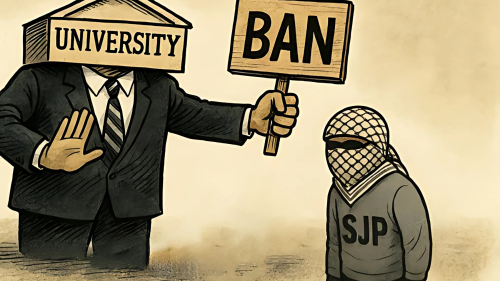 Universities Wrestle With How To Confront Students for Justice in Palestine, With Responses Ranging From Payouts and Probation to Multi-Year Suspensions and Permanent Bans
 -
 A Myth Needs to Be Continually Retold and Revived to Stay Alive


Gaza

-
 Trump’s Choice Between Gulf Pragmatism and Islamist Opportunism Will Define Whether Gaza Becomes a Model of Reconstruction or a Warning for the Region
 -
 Egypt’s Double Game Continues, Using State-Sponsored Media to Fuel Hatred While Pretending to Be a Partner for Peace
 -
 The First Phase of the Ceasefire in Gaza Is Still in Effect, but It Remains So Only Because of a Concerted Diplomatic Effort from the United States
 -
 The Ceasefire in the Gaza Strip Has Been Fragile Since U.S. President Donald Trump Willed It Into Existence Earlier This Month


