

Tebboune’s New Laws Tighten Political Control While Presenting Themselves as Modernization

Not All Alawite Experiences on the Coast Are Uniformly Bad. Some Alawite Localities Have Enjoyed an Overall Better Relation with the New Authorities

When Turkish Networks Move Money, Weapons, People and Narcotics Across Borders, They Export Not Only Violence but Also the Institutional Weaknesses and Culture of Impunity

Washington Has Now Connected the Entire Transnational Network and Exposed Its Operational Core in Khartoum

Mojtaba Is a Fraud Under the Islamic Republic’s Constitution, Which Sets ‘Grand Ayatollah’ as the Full Rank for the Supreme Leader

Politicking Had a Place When Regime Change in Iran Was a Distant Dream, but Game-Playing Is Counterproductive as Its Reality Looms

Trump Should Direct the U.S. Military to Hunt Down Regime Officials in Iran’s de Facto Wartime Capital

As a Major Non-Nato Ally, Morocco’s Economic Capacity Is a Direct Component of Regional Stability in the Maghreb and the Sahel

The Trump Administration Should Treat Ideological Proximity, Not Direct Culpability, as the Standard for Retaliation

Gorton and Denton Poll Marked by Voter Fraud and Canvassing in Urdu, Bangla

The Kurdistan Democratic Party of Iran Had Begun Preparing Organizational Networks Before Iran’s 1979 Revolution

The Responsibility for Liberating Non-Kurdish Areas in Iran Should Fall on the Populations Who Live There

A Technical Maritime Boundary Disagreement Has Evolved Into Geopolitical Confrontation

Destroying Guard Posts on the Island Sets the Stage for U.S. Forces to Occupy It and Protect Its Oil Facilities for a Post-War Economy

A Survivor, Ghalibaf Has Established Contact with U.S. Intelligence and Convinced Trump That He Can Deliver Security
Spotlight on a Deal with Iran
There have been many claims of an imminent deal between the United States and Iran recently. No deal has emerged and many versions have been floated as both sides jockey for an advantage in negotiations. The regime seems as recalcitrant as ever.
The most recent version on May 28th is purported to simply be awaiting signatures from the leaders of both countries. Is there a deal to be made that is worth doing or is the regime simply too much of an impediment to the security in the region? MEF fellows and experts weigh in on all of this.
The most recent version on May 28th is purported to simply be awaiting signatures from the leaders of both countries. Is there a deal to be made that is worth doing or is the regime simply too much of an impediment to the security in the region? MEF fellows and experts weigh in on all of this.

As unrest spreads across Iran, the regime and the opposition both face narrowing choices.

Military Officials May Believe the Civilian Governing Structure Is Too Fragmented and Indecisive to Manage the Country

Why the Newly Revealed American-Israeli Plan Never Stood a Chance

Once Trump Has a Credible Partner, He Should Dictate the Terms

Iran’s Competing Power Centers Are Shaping Negotiations, Escalation Risks, and Regional Strategic Decisions

Spotlight on the Gulf States
The combined US and Israeli war against Iran also drew in a number of the Gulf States. Iran’s decision to attack them immediately after Operation Epic Fury began was meant to split them away. In perhaps the most fatal mistake for its survival, it ended up bringing them closer and creating a counter-Iran alliance.
The Abraham Accords are back under discussion and an idea of what type of power structure will replace Iran and its proxies has begin to emerge. That must survive the usual rivalries between the Gulf States themselves, but it seems to be a positive development.
The Abraham Accords are back under discussion and an idea of what type of power structure will replace Iran and its proxies has begin to emerge. That must survive the usual rivalries between the Gulf States themselves, but it seems to be a positive development.

Iran’s Broader Objective Appears to Be the Gradual Decoupling of Arab Oil Producers of the Persian Gulf from the U.S. Security Umbrella

A Consequential Fault Line in the Middle East Runs Not Just Between Riyadh and Tehran but Between Riyadh and Abu Dhabi

How a Coordinated International Campaign Is Targeting the United Arab Emirates

The Pipeline Would Cost Billions of Dollars, Take Years to Build, and Would Cross Multiple Jurisdictions, Not All of Them Reliable

The Decision Sends a Signal That National Priorities Now Outweigh Collective Discipline

Recovery Will Not Be Simply a Return to the Old Model, Now That Gulf States Are Diversifying Their Energy and Economies
Middle East Quarterly - Summer 2026
Founded in 1994 by Daniel Pipes, MEQ is the Middle East Forum’s journal intended for both scholars and the educated public. Policymakers, opinion-makers, academics, and journalists write for and read the Quarterly, which is known for exclusive interviews, in-depth historical articles, and book reviews on subjects ranging from archaeology to politics and on countries from Morocco to Iran.
Summer 2026 Volume 33: Number 3
Summer 2026 Volume 33: Number 3


Middle East Forum Observer
Founded in 2024, the Observer provides rapid analysis on leading Middle East developments, from Marrakech to Mashhad and the Bab el-Mandeb to the Black Sea.


Launched in 2006, Islamist Watch is a project of the Middle East Forum. We work to combat the ideas and institutions of lawful Islamism in the United States and throughout the West. Arguing that “radical Islam is the problem, moderate Islam is the solution,” we seek to expose the Islamist organizations that currently dominate the debate, while identifying and promoting the work of moderate Muslims.

CAMPUS WATCH, a project of the Middle East Forum, reviews and critiques Middle East studies in North America with an aim to improving them. The project mainly addresses five problems: analytical failures, the mixing of politics with scholarship, intolerance of alternative views, apologetics, and the abuse of power over students. Campus Watch fully respects the freedom of speech of those it debates while insisting on its own freedom to comment on their words and deeds.


Gaza

-
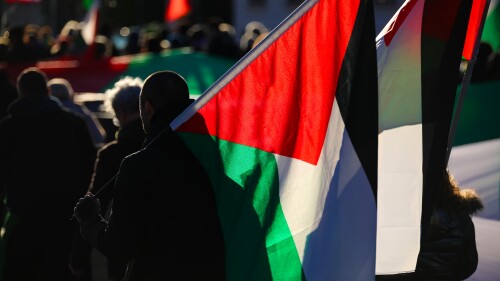 The Way Forward for Those Seeking Independence Is Accountability for Their Actions and Rule of Law
 -
 Hamas Now Stands to Rebuild Its Rule over Gaza, and to Reconstitute Its Hold on the Strip
 -
 Before and after October 7, Israeli authorities have permitted radical Hamas-aligned Western Islamist charities to enter Gaza and work openly with Hamas terror leaders, with some convoys even arriving from the Israeli side of the border.
 -
 The World Often Rewards Those Who Shout the Loudest Rather than Those Who Anchor Their Claims on Solid Ground


