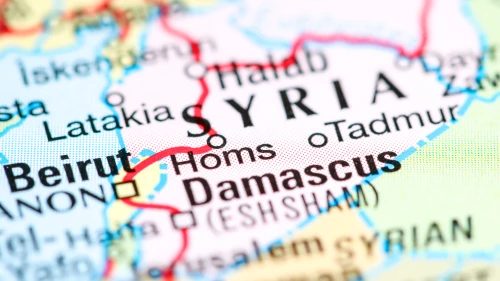
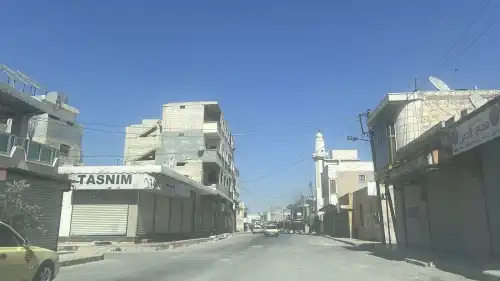
It has been more than a year since the coastal massacres in which large numbers of Alawite civilians were killed by government forces and pro-government militiamen following a coordinated Alawite insurgent attack on government positions in Latakia. As shown in a recent investigative report by the New Arab, the process of real accountability for the massacres has been seriously flawed in both evidence gathering and investigation, while for many survivors of the massacres, the publicised trials seem more for political show and optics.
But not all Alawite experiences on the coast are uniformly bad. Some Alawite localities have enjoyed an overall better relation with the new authorities.
As shown in a recent investigative report by the New Arab, the process of real accountability for the massacres has been seriously flawed in both evidence gathering and investigation.
The locality of al-Bahluliya is one such example (for some useful prior work on al-Bahluliya, see Gregory Waters’ reporting). But such cases should not be used to whitewash or downplay broader issues facing the Alawite community’s relationship with the new government. Rather, they provide local nuance. As an analogy, consider the two Twelver Shia villages of Nubl and al-Zahara’ in Aleppo province that I documented in a recent journal article for the Middle East Quarterly. Although the two villages show a positive adaptation to the new order in terms of security and stability and this is an important local nuance to highlight, such experiences do not necessarily apply to the entire Twelver Shia community in Syria.
The following is a recent interview I conducted with a media activist from al-Bahluliya who spent a considerable amount of time in Brazil before returning to al-Bahluliya. He alternates time between Brazil and al-Bahluliya. The interview in many ways corroborates Waters’ findings.
Q: Was al-Bahluliya subject to the coastal massacres?
A: al-Bahluliya is a district comprising 55 villages, with al-Bahluliya serving as its centre. Many villages such as al-Mukhtariya and al-Sanobar were subjected to the massacres and lost a large number of martyrs, but in the centre of al-Bahluliya nothing happened. This is because the leader of the 77th brigade [of the army] protected the centre from other factions, forbidding entry at the time.
Q: How would you rate the economic and security situation in al-Bahluliya?
A: The economic situation affects not just us but all of Syria. There is poverty and hunger. The Alawite sect was historically poor and many thus joined the army. A household of four or five might have two or three who were military personnel. More than 1000 or 1500 people in al-Bahluliya were army personnel and are now sitting in their homes, and they have no lands or agriculture. People are suffering from poverty. As for the security situation, I would say there is no locality in Syria safer than al-Bahluliya. You can go out at 3 a.m. and shops are still open. The police and Amn Aam [Public Security Apparatus] came after the 77th brigade, and we have no major crimes or kidnappings in al-Bahluliya. The security situation is 100% good.
Q: What explains al-Bahluliya’s better relations with the authorities?
Our relations with our Sunni brothers are very strong. We live in better peace and security than under the former regime.
A: Many of the villages bore arms against the government, but not al-Bahluliya. We accepted the new regime and system and did not come out against it, and thus the security forces respected that. All the security personnel are from Idlib and Aleppo but the district director is from Salma in Latakia countryside. No one is more courteous than he is. The people at the police station are also very polite and courteous. Weapons were handed over with the attendance of the mukhtars in three contingents. We are a conciliatory people.
Q: What do the people of al-Bahluliya think of Shaykh Ghazal Ghazal* and ideas of federalism?
A: We have no relation with Shaykh Ghazal Ghazal- when he called for a strike, we kept our shops oppen. We also did not go on demonstrations. Some people from other villages cursed us and said: ‘You are traitors, you are dogs, you are with Ahmad al-Sharaa.’
Ideas of federalism are mistaken: I am in Latakia and we live together as Sunnis, Alawites etc. Federalism is not something natural. Our relations with our Sunni brothers are very strong. We live in better peace and security than under the former regime. No one asks where you are going or what you are doing or demands your ID.
—————
* Note: An Alawite cleric who has gained political prominence because of his fierce criticisms of the new government, and thus enjoys popularity among many Alawites who are skeptical towards Damascus.
Published originally on March 13, 2026.