

Islamic Relief USA’s Lawsuit Prompted in Part by Middle East Forum Research

A Military Chain of Command Is Far Less Likely to Compromise, De-Escalate, or Test a Diplomatic Opening

In Practice, Sectarian Identity and Geopolitical Interest Outweigh Claims of Pan-Islamic Unity

Turkuvaz Media Group Promotes Conspiracy Theories Portraying Jews as Criminals, Intelligence Operatives, and Members of a Global Cabal

Even Uncontested Skies Do Not Guarantee Political Outcomes on the Ground

Joe Kent’s Claims Collapse Against Iran’s Long Record of Targeting Americans

Washington Has Built up a Crisis-Response Network Capable of Amphibious Operations, Rapid Air Assault, and Swift Reinforcement

Strengthening Iraqi Kurdistan’s Defenses Would Help Alleviate Pressure on U.S. Personnel in the Region

Co-Production and Technology Transfer Are Central to the Relationship, and Israel Is Now Among India’s Leading Defense Partners

Statistics Indicate That a Determined Iranian and Allied Campaign Is Indeed Underway in Iraq, Making the Country a Third Front in the Current War

‘Only One Rule‒No Zios in Flat’

A New Investigation Reveals LDS Church Funding for Terror-Aligned Extremists is Far More Extensive Than Previously Thought

Iraq Has Not Reduced Output Due to Policy Decisions or Quotas—It Has Shut Down Production Because It Cannot Export

The U.S. May Try to Manage Markets and Tehran’s Internal Calculations, but Shouldn’t Expect Policy Change from the Regime

Riyadh Should Express Its Displeasure by Sending Home All Pakistani Residents and Workers
Spotlight on a Deal with Iran
There have been many claims of an imminent deal between the United States and Iran recently. No deal has emerged and many versions have been floated as both sides jockey for an advantage in negotiations. The regime seems as recalcitrant as ever.
The most recent version on May 28th is purported to simply be awaiting signatures from the leaders of both countries. Is there a deal to be made that is worth doing or is the regime simply too much of an impediment to the security in the region? MEF fellows and experts weigh in on all of this.
The most recent version on May 28th is purported to simply be awaiting signatures from the leaders of both countries. Is there a deal to be made that is worth doing or is the regime simply too much of an impediment to the security in the region? MEF fellows and experts weigh in on all of this.

As unrest spreads across Iran, the regime and the opposition both face narrowing choices.

Military Officials May Believe the Civilian Governing Structure Is Too Fragmented and Indecisive to Manage the Country

Why the Newly Revealed American-Israeli Plan Never Stood a Chance

Once Trump Has a Credible Partner, He Should Dictate the Terms

Iran’s Competing Power Centers Are Shaping Negotiations, Escalation Risks, and Regional Strategic Decisions

Spotlight on the Gulf States
The combined US and Israeli war against Iran also drew in a number of the Gulf States. Iran’s decision to attack them immediately after Operation Epic Fury began was meant to split them away. In perhaps the most fatal mistake for its survival, it ended up bringing them closer and creating a counter-Iran alliance.
The Abraham Accords are back under discussion and an idea of what type of power structure will replace Iran and its proxies has begin to emerge. That must survive the usual rivalries between the Gulf States themselves, but it seems to be a positive development.
The Abraham Accords are back under discussion and an idea of what type of power structure will replace Iran and its proxies has begin to emerge. That must survive the usual rivalries between the Gulf States themselves, but it seems to be a positive development.

Iran’s Broader Objective Appears to Be the Gradual Decoupling of Arab Oil Producers of the Persian Gulf from the U.S. Security Umbrella

A Consequential Fault Line in the Middle East Runs Not Just Between Riyadh and Tehran but Between Riyadh and Abu Dhabi

How a Coordinated International Campaign Is Targeting the United Arab Emirates

The Pipeline Would Cost Billions of Dollars, Take Years to Build, and Would Cross Multiple Jurisdictions, Not All of Them Reliable

The Decision Sends a Signal That National Priorities Now Outweigh Collective Discipline

Recovery Will Not Be Simply a Return to the Old Model, Now That Gulf States Are Diversifying Their Energy and Economies
Middle East Quarterly - Summer 2026
Founded in 1994 by Daniel Pipes, MEQ is the Middle East Forum’s journal intended for both scholars and the educated public. Policymakers, opinion-makers, academics, and journalists write for and read the Quarterly, which is known for exclusive interviews, in-depth historical articles, and book reviews on subjects ranging from archaeology to politics and on countries from Morocco to Iran.
Summer 2026 Volume 33: Number 3
Summer 2026 Volume 33: Number 3


Middle East Forum Observer
Founded in 2024, the Observer provides rapid analysis on leading Middle East developments, from Marrakech to Mashhad and the Bab el-Mandeb to the Black Sea.


Launched in 2006, Islamist Watch is a project of the Middle East Forum. We work to combat the ideas and institutions of lawful Islamism in the United States and throughout the West. Arguing that “radical Islam is the problem, moderate Islam is the solution,” we seek to expose the Islamist organizations that currently dominate the debate, while identifying and promoting the work of moderate Muslims.

CAMPUS WATCH, a project of the Middle East Forum, reviews and critiques Middle East studies in North America with an aim to improving them. The project mainly addresses five problems: analytical failures, the mixing of politics with scholarship, intolerance of alternative views, apologetics, and the abuse of power over students. Campus Watch fully respects the freedom of speech of those it debates while insisting on its own freedom to comment on their words and deeds.
Antisemitism

-
 The Slow Bleeding to Death of the Jewish State Is Part of Iran’s Ambition to Lead an Alliance of Islamic Governance
 -
 The Expressed Anti-american, Anti-Israel, and Antisemitic Sentiment Is Nothing New Among Middle East Studies Professors.
 -
 A Colombian Immigrant’s Journey Through Cultural Identity, Zionism, and the Backlash Post-October 7
 -
 Events unfolding in Denver serve as a cautionary tale, illustrating a movement rooted not in a sincere quest for justice, but in a troubling mix of ignorance and radicalism.


Gaza

-
 ‘Morag’ Is Intended to Drive a Wedge Between the Rafah and Khan Yunis Brigades of Hamas, and Then to Destroy These Formations
 -
 Gaza’s Powerful but Usually Cowed Clan Leaders Called on Gazans to ‘Launch a Popular Uprising’ and for Hamas to ‘Lift Its Hand from Gaza Immediately’
 -
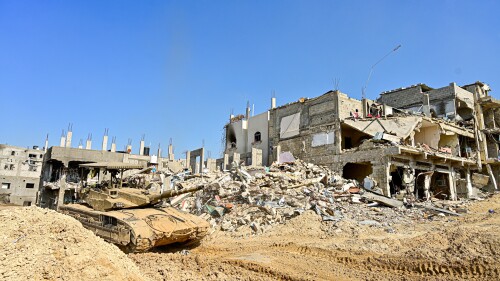 Pressure Mounts on Both Sides—Who Will Yield First in This Endless War?
 -
 The Plan Is a Dangerous Scheme That Threatens Israel’s Security, Strengthens Hamas, and Undermines U.S. Strategic Interests


