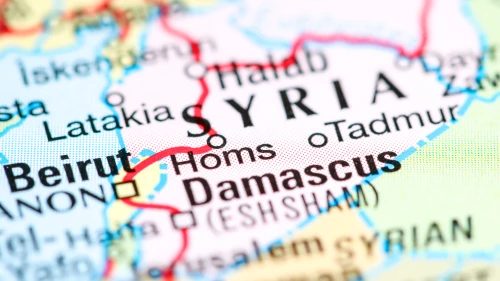
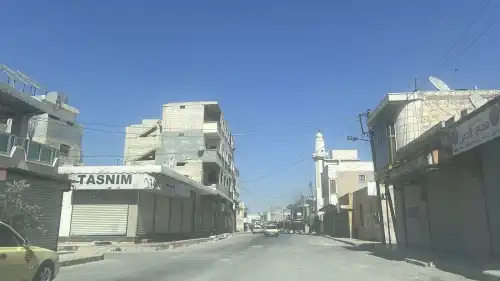
With the passing of one year since the fall of the Assad regime, the situation in al-Suwayda’ province still remains at an impasse between the Syrian government forces that control northern and western countryside areas, and the rest of the province under the control of local Druze factions, most if not all of which are nominally united under the ‘National Guard’ project endorsed by Druze spiritual leader Hikmat al-Hijri.
Among those ‘National Guard’ factions is Quwat al-Mithaq (“The Covenant Forces”), whose leader Hasan al-Othman I recently interviewed regarding the latest developments and outlook in the province, including the controversy surrounding a recent alleged ‘conspiracy’ of collaborators working with the government.
We abandoned our work and livelihoods for the sake of defending our land after the crimes committed by Jowlani’s followers.
Q: When was Quwat al-Mithaq formed?
A: It was formed just before the prior regime fell. Our position started out from Dignity Square in defence of our land and honour. We are a moderate group and were not affiliated with any side. We abandoned our work and livelihoods for the sake of defending our land after the crimes committed by Jowlani’s followers against our Druze people in Sahnaya, Ashrafiyat Sahnaya and Jaramana in Damascus countryside.
Q: In your view is the ‘National Guard’ project successful or are there still problems of factionalism? And amid the current situation is the only option complete independence from Syria?
A: The National Guard is an organised formation under a wise leadership that has included most of the factions of al-Suwayda’. It possesses sovereign decision-making in al-Suwayda’. Regarding independence, this is an state project in which we have no decision. We want security and peace and to secure a future and dignified life for our children.
Q: Do you personally think that it’s possible for al-Suwayda’ to be part of Syria if the government apologises for its crimes and actually holds those who committed violations to account?
A: This is a Salafi jihadist government that cannot change.

Q: The government in Damascus has announced establishing an investigative committee to look into the massacres and crimes committed in al-Suwayda’. Likewise it has announced a trial for holding accountable those who committed the violations in the coastal region. In your view are these procedures not serious and active?
A: It’s a double-crossing and lying government: how can the criminal put himself on trial? Mr. Aymenn, in al-Suwayda’ we have a proverb: they kill someone and then participate in his funeral procession. The government is like this: it has killed people and is now participating in their funeral procession. A government that does this is double-crossing and lying.
In al-Suwayda’ we have a proverb: they kill someone and then participate in his funeral procession.
Q: We have seen demonstrations in the coastal region and Homs. What’s your position on these demonstrations and do you support the idea of an Alawite region in Syria?
A: The demonstrations in the coastal region and Homs have justified demands. They have faced violations that all followed on global media channels. We stand with them as a humanitarian position.
Q: What do you think of the idea of an alliance with the SDF to form a single autonomous administrative region?
A: An alliance with the SDF, as a societal view here in al-Suwayda’: we don’t have a problem with allying with any person, state or alliance that ensures our dignity, the dignity of our children and and the future of our children and families.
Q: What has to happen in Damascus so that there can be a return to negotiations with the central government?
A: With regards to dealing with Damascus, the Salafi government is still present. There is no light at the end of the tunnel. We say there cannot be any dealing with the government right now because we have more than 4000 martyrs, burned and plundered homes, and 170 women, men and elderly taken hostage.
Q: How do you assess Israel’s role in al-Suwayda’ and Syria?
A: Our position on Israel, as the entire society of al-Suwayda’ province, is that Israel saved and delivered us, because it stood with us amid great violations or the genocide that our sect was exposed to at Damascus’ hands. So the overwhelming majority in al-Suwayda’- or let us say, God willing, 90-95% in the region of Jabal Bashan- are with Israel.
The current government is not in a position to cut off aid or goods from al-Suwayda’ province because of international and regional pressure.
Q: Recently the ‘National Guard’ put out a statement about uncovering a conspiracy. In your view are some people in al-Suwayda’ trying to contact the government because of the difficult humanitarian situation? And in your view do those who contact the government deserve arrest and imprisonment?
A: There is no contact between the National Guard and the leadership in Damascus/interim government. Praise be to God, the humanitarian situation is acceptable in al-Suwayda’ province until now, and the current government is not in a position to cut off aid or goods from al-Suwayda’ province because of international and regional pressure. Because of regional and international support and the support of friends and brothers from the Druze sect in all the neighbouring and friendly states, the situation is acceptable praise be to God, and we can consider everything under control until now, until we can either come to terms with a moderate government in Damascus or completely separate from this government and establish an independent state, God willing.
Published originally on December 10, 2025.