In a previous detailed report I did on the Afrin region, I noted that one could observe a genuine trend of the original Kurdish inhabitants returning to Afrinafter large-scale displacement and extensive property rights violations committed in 2018 during Operation ‘Olive Branch’ when the Turkish military and Turkish-backed Syrian rebel groups dislodged the Kurdish-led ‘Syrian Democratic Forces’ from the region. Further, in general, both in Afrin and thewider north Aleppo region, Turkish influence over local administration has reduced as the new central Syrian state has established and consolidated institutions.
However, there are some caveats to this general assessment.
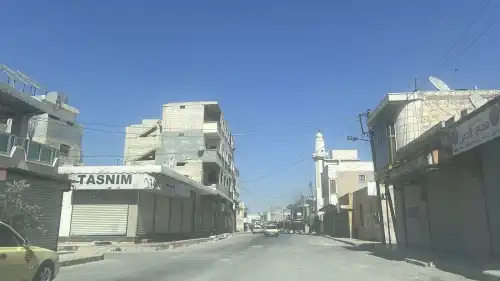
Most notably, it is true that the Turkish military is still present in some bases inthe region. In some cases, this military presence co-exists with local inhabitants, but in other cases it does not. One example of the latter sort ofsituation is the village of Jelbol (Kurdish: Cilbirê). I happened to pass through thevillage recently and was immediately struck by the fact that it was silent and deserted as far as I could tell.


Not long after I passed through the village, the apparent reason became clear. There is a Turkish military base in the vicinity of the village, with another smaller facility used by the Turkish military lying to the north in the area of the villages ofInab and Maryamayn. The existence of this Turkish military base in the area has long been reported by Kurdish media activists from Afrin. I can confirm its continued presence.
In fact, just as I passed by the entrance to the large Turkish military base, a Turkish military vehicle came out and went on its way to the smaller facility (see below: it was obviously Turkish from the Turkish writing on the vehicle, though for security reasons, I did not take a close-up photo where this writing can be seen). As I continued along the route other Turkish military vehicles passed by inthe other direction, probably heading back to the base in Cilbirê.
I should stress however that these military vehicles were not functioning as an occupation force in the sense of running checkpoints in Inab and Maryamayn or on the route from Cilbirê to Inab and Maryamayn. Rather, their presence at this point seems to be similar to the American military presence that existed innortheast Syria, where observers regularly noted the existence of bases for theAmericans and reported and photographed sightings of American military vehicles on the road.


As I passed through Inab and Maryamayn, I also happened to stumble upon a former base of the Hamza Division, which was one of the main Turkish-backed Syrian National Army (SNA) factions and was merged into Division 72 of the new Syrian army. Like other such facilities I have observed in the region, it now lies empty and deserted- a testament to the fact that there is something to theabandonment of fasa’iliya (‘factionalism’) in the sense of abandoning theinsignia and names of the factions in building the new military and security apparatuses- different from, say, Iraq’s Popular Mobilisation Forces where various brigades exist but the factional identities very much persist. Indeed, a Syrian army soldier whom I gave a ride during this trip and who said he was originally from Jarabulus (in north Aleppo countryside on the border with Turkey) stressed the importance of abandoning factionalism in order to build a successful state.
Heading back through Cilbirê a second time, I decided to take a closer look at one of the ruined homes. Inside was graffiti in Turkish (photos below with my translation), evidently left behind there by the Turkish army.

![‘Greetings to his family from Afrin’ [effaced writing above it].](https://cdn-mef.meforum.org/dims4/default/cfa04cd/2147483647/strip/true/crop/1100x619+0+103/resize/1000x563!/format/webp/quality/90/?url=https%3A%2F%2Fk2-prod-mef.s3.us-east-1.amazonaws.com%2Fbrightspot%2Ffb%2Fa2%2F15ebaa3642c084dec2e145f01b3a%2Faymenn7.jpeg)

It is of concern that Cilbirê’s original inhabitants are reportedly barred from returning to live in the village because of the Turkish military presence, although they can visit for purposes such as burying relatives or simply wandering about and seeing what remains of the village, since there are no special checkpoints guarding the village’s entrance and exit routes, based on what I observed. Just over a month ago, a Kurdish media activist from the village mentioned theprohibition on returning to live there in a post he made about an Eid visit to thevillage by some locals:

‘Despite the prohibition [on returning] and the ruin that has befallen the village, an Eid gathering in front of what remains of the village guest house with cousins, after visiting the graves in our village of Jelbol (Cilbirê). Mercy be upon those who have left us for their Lord, and long life and good health for all.’To conclude, I would like to emphasise that the purpose of this post is not to advocate for the SDF (which as an autonomous political project is more or less finished) or score some polemical point on the Internet against the Syrian government or Turkey. Rather, I am highlighting what I have observed because it is an on-the-ground, independent corroboration of previous reports about thevillage being deserted and destroyed with a Turkish military base. We should highlight what we observe and use it to suggest a productive way forward, foremost for Cilbirê’s original inhabitants. In this case, with the SDF having long been done away with in Afrin and with the SDF enclave no longer existing inAleppo city, there is no real justification- in my view- for Cilbirê’s original inhabitants to be barred from returning to rebuild their homes and live there. There are, after all, inhabited Kurdish villages not too far away in the same area. To build goodwill with Cilbirê’s original inhabitants, the Syrian government, Turkey or independent NGOs should help raise funds for renovating and rebuilding the damaged properties there.
NB: The photos and text in this post may not be reproduced elsewhere in theform of screenshots etc. without my explicit permission. Please contact me if you would like to do so.