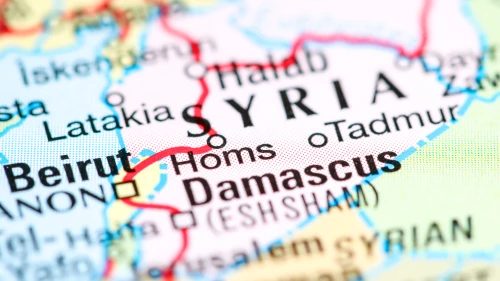
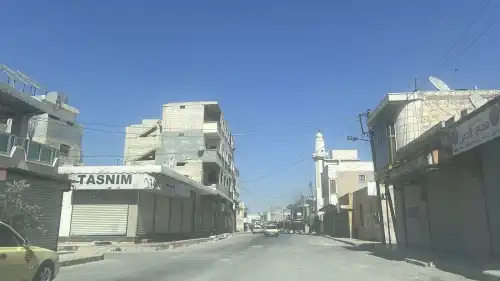
The Afrin Region and the Kurdish Populations
The following report, commissioned as a field assignment by the Middle East Forum, is an in-depth examination of the Afrin region located in northwest Syria along the border with Turkey. The region is known for having had a majority Kurdish population prior to the war and up to 2018, when much of the Kurdish population was displaced during an offensive led by Turkish-backed Syrian insurgents who, operating under the framework of operation “Olive Branch,” seized control of the area. This report, based on interviews conducted with Syrian government officials in the Afrin region, travel within the region, and other sources, focuses on the situation following the Assad regime’s fall, particularly the prospect for the return of the original displaced Kurdish population. The report also analyzes the status of the Afrin region’s small Yezidi minority.
Background on the Afrin Region
The Afrin region lies in the northwest corner of Aleppo governorate, bordering Turkey. Its internal boundaries within Syria are roughly delineated by the town of Azaz to its east and the towns of Nubl[i] and Atmeh to its southeast and southwest respectively. Its primary center is the city of Afrin located in the middle of the region. Although the city of Afrin itself has relatively recent origins (having experienced development beginning in the French mandate era of Syria), it is generally accepted that the region’s Kurdish population was indigenous and likely constituted the majority of the region’s population. There is also an Arab minority population that was settled in the Afrin region prior to the war, with roots going back to earlier migrations from the Jazira region in northeast Syria (i.e. east of the Euphrates River).[ii]

As Syria descended into civil war, a key problem faced by the Assad regime from the outset was a lack of effective manpower to retain control of more remote, primarily rural areas. Thus, beginning in 2012, the regime engaged in tactical withdrawals from certain parts of the country, particularly the majority Kurdish regions of Syria along the country’s northern border with Turkey. The vacuum left by these withdrawals was primarily filled by the Kurdish-led Democratic Union Party (PYD), linked to the Kurdistan Workers Party (PKK). The PYD imposed security control through its own armed wing—the People’s Protection Units (YPG)[iii]— and set up its own comprehensive administrative system known as the Autonomous Administration, designating the Afrin region as a “canton.”
The PYD’s system of governance conferred some advantages relative to the insurgent-held areas in the earlier years of the war. That the PYD generally did not pursue a policy of active hostility towards the regime but was rather primarily interested in controlling Kurdish majority areas from which the regime had pulled out meant that the PYD areas were normally spared the airstrikes and offensives the regime launched against insurgent-held areas. Furthermore, the PYD’s system effectively translated to the hegemony of a single faction over substantial contiguous swaths of territory, as opposed to the insurgent-held areas that tended to be characterized by multi-factional rule and were thus more chaotic. As such, when the Afrin canton existed, it was perceived as an area that provided security and peace relative to other parts of Aleppo province.[iv] Against that, the PYD system was criticized for enforcing a system of conscription, authoritarian cronyism, and realizing little to no progress in development projects.[v]
Turkey’s intervention ended hopes of Kurdish territorial continuity and reshaped control of the Afrin region.
From the perspective of the insurgency and political opposition to the Assad regime, the PYD was viewed with suspicion as a supposed collaborator with the regime. In addition, its autonomous administration project was frequently denounced as amounting to an attempt to partition Syria, as opposed to the insurgency and opposition’s preference for a united Syria under a single central authority. Regarding the Afrin area, suspicions of the PYD were reinforced by the Afrin canton’s serving as a lifeline for the besieged, regime-loyalist Shia towns of Nubl and al-Zahara’ (2012-2016), as residents of the two towns were able to procure food supplies and other goods from the Afrin canton.[vi] In addition, in early 2016, as the regime and its foreign allies sought to encircle the rebel-held parts of Aleppo city and pushed north of Aleppo city itself as part of this encirclement, the YPG—operating under the brand name of the SDF (Syrian Democratic Forces, which was itself devised by the U.S.-led coalition as part of the war against Islamic State)[vii]—seized the town of Tel Refaat and other neighboring localities from the insurgents in February 2016, triggering the displacement of most of the local population. This move likely occurred because the YPG expected the insurgents in the north Aleppo countryside to collapse and so eventually hoped to link up with the SDF east of the Euphrates River.
This hope never materialized, as Turkey intervened in the north Aleppo countryside under the framework of operation “Euphrates Shield” at the end of August 2016, deploying troops and military support for various Syrian insurgent groups. These groups were subsequently organized into a coalition of factions called the “Syrian National Army” (SNA), principally divided into three corps. Constituent groups enjoyed varying degrees of confidence with the Turkish military and intelligence apparatuses.
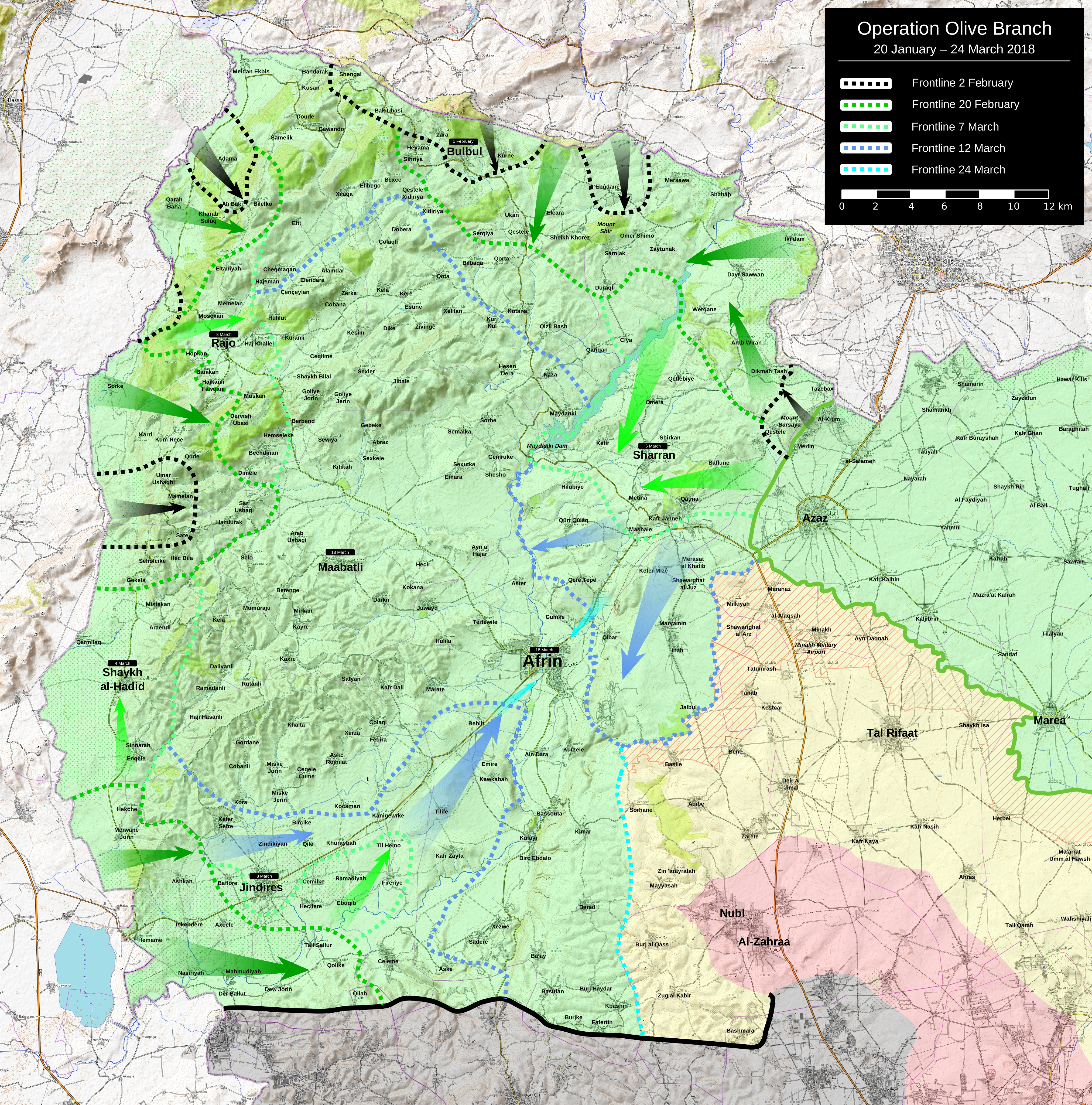
Although the immediate target of “Euphrates Shield” was the Islamic State, which controlled much of the north Aleppo countryside east of the small insurgent-held enclave north of Aleppo city, Turkey also likely sought to prevent the Afrin-based YPG from expanding further, viewing them as a security threat because of links to the PKK. The same perception of the YPG as a security threat motivated Turkey to devise the “Olive Branch” operation with SNA allies and invade the Afrin region, expelling the YPG in early 2018. The offensive was launched after Russia effectively consented to the operation by withdrawing its symbolic presence from Afrin that otherwise deterred the action. Facing an overwhelming disadvantage in firepower and manpower, the YPG’s defenses in Afrin quickly collapsed, with the remnants fleeing into Kurdish neighborhoods of Aleppo city (where the YPG also had a presence) and the Tel Refaat area.[viii]
The operation triggered a widespread displacement of the local Kurdish population, who understandably feared maltreatment at the hands of Turkish forces and the insurgents and thus fled towards regime and YPG-held areas in Aleppo and SDF-held areas elsewhere in Syria. In turn, SNA groups opportunistically exploited this displacement by confiscating substantial amounts of displaced Kurds’ real estate, whether in the form of residential homes, businesses, or agricultural land. Many Syrian Sunni Arabs displaced from other parts of the country—for example, the East Ghouta region of Damascus that was seized by the regime in spring 2018—took up residence in properties of displaced Kurds, bringing about a de facto demographic change.
Further, Turkish forces established military bases in the Afrin region.[ix] Some of the sites of these bases are still present, but the Turkish forces generally stay within the bases and do not act as an occupation force through functions like running checkpoints. Signs of Turkish influence from the period 2018-2024 are more visible in the display of Turkish flags alongside the flag of “Free Syria” and bilingual usage of Turkish and Arabic (for example, on billboards erected by the local councils at the time, in a show of appreciation of Turkish support for local councils and their projects).[x] In Afrin city, some businesses’ shutters have the Turkish flag painted on them, somewhat similar to the way many businesses in former regime-controlled areas were painted with the former regime’s flag in an ostensible show of loyalty to that regime.[xi]
The Return of Confiscated Property After the Fall of the Regime
Far from being mere allegations put out by SDF/YPG supporters, the wide-scale property rights violations committed by SNA factions are attested by two observations. First, when travelling through the Afrin region, one can see some property marked by SNA factions’ graffiti, suggesting that they had confiscated those properties at some point.[xii]
Second, the transition government that has emerged following the Assad regime’s fall has established mechanisms for returning confiscated property to displaced persons. If property rights violations were not a major issue in the Afrin region, those mechanisms would not have been put in place.
A key motive behind the transition government’s actions is its vision for a centralized system of authority in Syria. Prior to the fall of the regime, the Afrin area had been part of a Turkish-backed SNA enclave that was administratively distinct from the area of Idlib and its environs controlled by Hay’at Tahrir al-Sham (HTS) and its Salvation Government (SG), which spearheaded the offensive that brought down the Assad regime. The transition government, whose most important positions are occupied by HTS and SG figures,[xiii] has sought to bring the previously distinct enclaves under a unified system of administration. Furthermore, the transition government seeks to refute the SDF’s claims that only a decentralized, federal system (which would mean central government recognition of the SDF’s autonomous system in north and east Syria) can guarantee the rights and representation of Syria’s ethnic and religious minorities. Thus, the central government obviously has an interest in seeking to ensure the return of displaced Kurds and attempting to show that their rights are protected in Afrin.[xiv]

Administratively, the Afrin region has seen a notable shift with the cancellation of the area’s various local councils, which were generally independent of each other. The local councils have been replaced by a central directorate for the Afrin region (“The Afrin Region Administration”), which answers to the governor of Aleppo province.[xv] The Afrin region is in turn divided into district directorates that answer to the central region administration. This administrative change mirrors to some degree what happened in SG areas prior to the fall of the regime, whereby many local councils were abolished and replaced by municipal offices covering multiple localities.
The directorates are responsible for overseeing the return of property. Specifically, according to the heads of the Afrin and Jindiris directorates,[xvi] any displaced person who wishes to reclaim his/her property must do the following: first, the person must get the documents that prove ownership validated by a lawyer approved for the relevant district. Validation can generally be secured with the help of a local mukhtar (a local village or neighbourhood figure who helps with certification of documents in dealing with the authorities) and local witnesses. If the documents are validated by the lawyer, the person must then submit the documents to the “economic committee”[xvii] office run by the district directorate. The “economic committee” office then makes a referral to the central economic committee for the Afrin region for final validation.[xviii] Per this official narrative, the claimant’s adequate proof of ownership is sufficient to have it returned.
When I asked what happens in the scenario whereby a confiscated property is occupied by a displaced family that cannot return to its original home because it is destroyed, the Afrin administration head claimed that either an attempt would be made to secure some kind of agreement between the displaced family and the original owners (e.g. a rental contract) or the displaced family would be provided alternative accommodation in camps.[xix]
The return of property has become a test case for the transition government’s claim to centralized authority.
Similarly, the Jindiris district director said that some original owners prefer to grant rental contracts to those living in their homes, but in coordination with the Afrin regional administration, 3,000 apartments (primarily built by NGOs in response to the 2023 earthquake) have been set aside to accommodate people who might have to be evicted but cannot secure alternative accommodation.[xx] He also said that the administration does not discriminate in returning confiscated property: for example, a person who worked in the Afrin canton’s Autonomous Administration should not be barred from being able to reclaim property.[xxi] The only supposed exception is someone deemed to be bearing arms against the state—in practice, excluding active members of the SDF’s forces from reclaiming property.
Pro-government media and sources have advertised purported instances of return of confiscated property and also offered some statistics in this regard.[xxii] For example, pro-government sources asserted in November that around 5,000 houses in Afrin had been returned to their original owners whereby the occupants had departed.[xxiii] Moreover, more than 500,000 olive trees (for which the Afrin region is renowned) had supposedly been returned to their original owners.[xxiv]
Critics—particularly those supportive of the SDF—assert that the “economic committee” mechanisms are intended to legitimize armed groups’ confiscation of property, and that the mechanism for return of property is arbitrary. For example, pro-SDF commentators shared a video in early September of an individual from Jindiris who had been living in exile in Turkey, claiming that he had unsuccessfully tried to appeal to multiple times for the return of his home that was being occupied by displaced people from Hama.[xxv] The Jindiris regional director appeared to comment on this incident, suggesting that the clip was misleading in that the house in front of which he filmed the clip did not actually belong to him and that the directorate was in the process of restoring another property for which he could prove his ownership.[xxvi]
The Presence of Kurds in Afrin
Verification of precise statistics on claimed returns of confiscated property is difficult, but it is possible to address through observation and interviews whether Kurds are in fact returning to Afrin. The impression from these lines of evidence is that there is a genuine phenomenon of Kurds returning to Afrin or at least coming for visits in a way that did not exist prior to the fall of the regime. For example, within Afrin city itself and in the wider area, Kurds can now be more readily observed on the streets and within shops.[xxvii] Kurdish women in the area, particularly of the younger generation, are often distinctly recognisable for the lack of a hijab and Western-style clothing, as opposed to Afrin’s prior existing Arab population and more recent Arab IDPs for whom more conservative dress and the hijab are the norm.[xxviii] I did not get the sense that these women feared harassment for dressing differently from their more conservative neighbors. Similarly, during the meeting with the Jindiris regional director, participants made clear that the hijab is a matter of personal choice in which the government does not interfere.
There is a genuine phenomenon of Kurds returning to Afrin—or at least visiting—in a way that did not exist previously.
Furthermore, the Kurds who are present readily use Kurdish in public, and I never sensed that they felt afraid to speak Kurdish. Some store and notice signs written in Kurdish (Kurmanji- Latin script) are also visible in the Afrin area. In the Jindiris district, following my meeting with the district director, I was able to visit a hall where a lively Kurdish wedding was being held, as well as a restaurant nearby where alcoholic beverages were available for sale. None of the people in either location claimed they were being subject to harassment by the authorities for reasons such as playing music or selling alcohol. Nor did they feel that their freedom to celebrate their Kurdish identity and culture was being suppressed.
In this context, however, some observation should be made on the issue of teaching Kurdish in schools. There is some provision for teaching Kurdish in Afrin, but it is clear that there is no intention to make it the primary language of instruction, but rather treat it as a foreign language.[xxix] Some Kurds in the region do not necessarily disapprove of this move on practical grounds. For instance, one Kurdish businessman in Jindiris noted by comparison how Kurdish had become the primary language of instruction in the Kurdistan region of Iraq (KRG) with the result that fewer and fewer Kurds in the KRG have a grasp of Arabic, thus making it difficult for them to work outside the KRG or in the wider region.[xxx] Of course, some SDF supporters who are keener on giving Kurdish a more central role in education would disapprove of the arrangements in Afrin.
Estimates on the percentage of displaced Kurds who have returned to Afrin vary. It is difficult to be sure about their veracity given the wide range. For example, one Kurdish resident of Afrin said that the proportion that has returned is in the range of 30-40 percent.[xxxi] Conversely, a person based in SDF-held areas who heads an organization for displaced Kurds from Afrin put the percentage of returnees at 60 percent, noting also that his own family had returned to Afrin.[xxxii]
There is some provision for teaching Kurdish in Afrin, but it is clear that there is no intention to make it the primary language of instruction.
Even so, he claimed that the transition government was not taking active measures to restore property to original owners: “Because Afrin, Azaz, al-Bab, Jarabulus. and Manbij are under Turkish guardianship: those who have authority are the Amshat,[xxxiii] Hamzat,[xxxiv] and Sultan Murad, while the role of the Amn Aam[xxxv] is weak at the current time.” But when asked how 60 percent of the displaced from Afrin could have returned since the fall of the regime if this were the case, he clarified: “Before the fall of the regime, the situation in Afrin was very very bad, but after the fall of the regime there has been some change, yet there is still oppression.”[xxxvi] In his view, among the factors preventing a larger return of Afrin’s displaced Kurds is the influence of Turkish-backed SNA factions: “The problem is the factions linked with Turkey are still all present there. If the Amn Aam alone were controlling Afrin, you would find that 99 percent of people would have returned.”[xxxvii] Conversely, the Afrin regional director pinned part of the blame on the SDF and Kurdish media that portray the SDF as the Kurds’ protector. He asserted, for example, that during a visit to Qamishli, the SDF would not let him meet with displaced people from Afrin in order to discuss how they could return home.[xxxviii] He did, however, offer some statistics on return of Kurds to the Afrin area, claiming that 14,000 families had returned and recovered their property but returned to other areas like Aleppo city and Hasakah, while 12,000 families had returned and stayed.[xxxix]
Security factors aside, a possible incentive for the return of some Kurds to the Afrin area is that the services situation may be better than in areas controlled by the former regime and/or the SDF. Afrin city itself, for example, has had many of its roads renovated and developed, similar to what can be observed in the town of Azaz. Further, Afrin city is connected to the wider Turkish electricity network, giving residents much cheaper and more abundant electricity in comparison with former regime-held and SDF-held areas. The city council also introduced renovations and improvements to the sewage network and built new health facilities.[xl] In an interview, the head of the Afrin regional administration pointed to these accomplishments and asked me to consider by contrast what the SDF and the regime did to Tel Refaat in converting it into a military zone largely devoid of its original inhabitants.[xli]
SNA Factions in Afrin? Questions of “Transitional Justice”
Is the conception of the presence of SNA factions in Afrin as alleged by pro-SDF reports accurate? Certainly, prior to the fall of the regime, the presence of those factions and their influence in the Afrin area were very real. In a meeting with the Jindiris district director, one Kurdish interviewee noted that a problem during the “Olive Branch” era (2018-2024) was how the area was divided between different factions with a large number of checkpoints.[xlii] By way of example, he said that when he travelled from Jindiris to Shaykh Hadid, he would pass through 22 checkpoints.
By contrast, when I travelled in the Afrin area, it was striking how many signs of those factions’ presence had been removed. For example, on a route to Maydanki Lake, I found the remnants of a checkpoint that was run by the Sultan Murad Division[xliii] but which was dismantled following the regime’s fall. More generally, the number of checkpoints in the Afrin area has been greatly reduced. I myself did not observe any checkpoints being visibly run by members of SNA factions. Rather, those running the checkpoints appeared to be either Amn Aam[xliv] or transition government army personnel, who, as in other parts of Syria, often let vehicles through with minimal or no questioning. In a similar vein, within the town of Afrin, some remnants of the presence of SNA factions could be observed.
Estimates of Kurdish return to Afrin vary widely, reflecting both political bias and limited verification.
For example, I saw a small roundabout monument in Afrin dedicated to Syrian Kurdish opposition politician Meshaal Tammo (assassinated in 2011 and popular among the opposition to the Assad regime) and erected by SNA faction Jaysh al-Sharqiya.[xlv] But many other public displays— such as posters glorifying “martyrs” of SNA factions—had been removed. The Kurdish interviewee who mentioned the prior problem of numerous checkpoints noted the same observation regarding removal of factions’ posters and similar public displays in Shaykh Hadid.[xlvi]
Rather than being a mere propaganda exercise to impress outside observers, these efforts accord with the transition government’s desire to end factionalism that arose out of the insurgency and integrate the various armed groups into the new army and security apparatuses. This integration effort contrasts with the reality of the SNA prior to the fall of the regime, in which factions were assigned division and brigade numbers but did not lose their factional identities, in the same way that many Iraqi militia factions integrated into the Hashd Commission have never shed their factional identities. Within the Afrin area, the most notable new army division present is Division 80, which is presently led by Ahmad Rizq[xlvii] and contains a mixture of personnel from Harakat Nur al-Din al-Zinki, Liwa Samarqand, Liwa al-Shamal, Faylaq al-Sham, and the Mutasim Division[xlviii]: in other words, primarily SNA groups and junior partners of HTS. In contrast, the “Amshat” has largely been incorporated into Division 62, which is headed by Abu Amsha and is primarily operating in Hama province, while the “Hamzat” have been primarily incorporated into Division 76. “Ahrar al-Sharqiya” (Free Men of the Eastern Region), another faction that gained notoriety for violations committed in Afrin and against Kurds elsewhere,[xlix] has been incorporated into Division 86 (headed by Ahrar al-Sharqiya’s leader) and primarily deploys in the eastern region of Dayr al-Zur near the borders with Iraq, including the border town of Albukamal.
But the shedding of factional names and incorporation of groups into new army divisions do not exclude the possibility that some individual figures and commanders within the old factions—now operating under the new army divisions—are still holding confiscated real estate in Afrin and refusing to hand over these assets to their original owners for reasons such as lack of alternative accommodation, self-enrichment, and patronage networks.[l]
Even critics acknowledge that conditions in Afrin have improved relative to earlier periods.
The Jindiris district director noted that members of now formally dissolved SNA factions were still present in “military barracks” but denied that they had any role in intervening in civilian life and or that the SNA factions existed as entities anymore.[li] He also admitted that initially, the presence of military personnel in confiscated homes and fear of SNA factions deterred original owners from seeking to recover their property.[lii] However, he asserted that the district economic committee has been coordinating with a committee from the Ministry of Defense to identify land and property assets being used by personnel of the now dissolved factions and specify which ones should come under the oversight of the Ministry of Defense, but in any case any person who could prove his/her ownership of a given property would still receive it from the economic committee, regardless of who the occupant might be.[liii] The earlier-mentioned Kurdish interviewee who noted problems of factions’ checkpoints claimed in the same meeting that so-called “war spoils” of SNA factions (i.e. Kurdish business and other property assets confiscated by them) have been handed over to the economic committees.[liv]
More broadly, the question of returning confiscated real estate raises issues of “transitional justice” and accountability in post-Assad Syria. Are the perpetrators of property rights violations in Afrin going to be held accountable for their actions? If there were the serious prospect of such perpetrators being subjected to legal consequences beyond merely being asked or forced to return confiscated property, it might reassure the still-displaced inhabitants of Afrin that the area is not simply under the rule of armed gangs and thus give an incentive for return.
However, it seems that such accountability is not forthcoming, given the new government’s decision to focus on crimes committed by the Assad regime during the civil war and fear of angering its popular support base. When I asked about the prospect of accountability in this regard, the Afrin administration head admitted that I had touched on an important issue but explained that if there were to be accountability for every violation committed in Syria, there would be few if any with clean hands.[lv] It is of course true that it is difficult if not impossible to ensure complete accountability for every violation committed for reasons such as insufficient evidence, perpetrators’ whereabouts, and the like. However, when some displaced people from Afrin see how leading figures of SNA groups accused of violations in Afrin not only face no accountability but enjoy senior positions within the new army, it is easy to see why they are still concerned about whether these groups wield influence in Afrin, even if their perception is somewhat divorced from the reality.
A Note on the Yazidi Minority

Although the Yazidis are primarily associated with Iraq and the Islamic State’s attempted genocide against the community there, there is also a small Yazidi minority in the Afrin area. The village of Qibar is one of the main settlements with a Yazidi population, but according to community elder Abu Stayf, only around half of the population is Yazidi.[lvi] The remainder of the population comprises primarily Sunni Kurds and Arabs of the region and Arabs who were displaced from other parts of Syria, including some members of factions like the Mutasim Division and Faylaq al-Rahman (the latter being a group originally based in East Ghouta but whose members were displaced to the north in 2018). Although the factional identities have been formally shed and Abu Stayf noted that he himself had generally been treated with respect by SNA factions, some of these armed groups’ members are still present in confiscated homes and have been asked to leave by their original owners, but they refuse to do so.[lvii] In other instances, some people who leave confiscated homes have taken property components like gates and doors. Despite the mechanism of appealing to the local authorities for return of property, Abu Stayf noted that there is fear among Yazidis from the village about formally lodging complaints.
Abu Stayf also noted that the community has faced some harassment from Muslims who seek to convert Yazidis to Islam, with proselytisers (likely Salafis) having approached him four times prior to the fall of the Assad regime (i.e., in the 2018-2024 period) and once following the fall of the regime. Further, some Yazidi graves and shrines have been subject to vandalism. More generally, Abu Stayf does not feel that there is a long-term future for the Yazidi community in the area, given that it is a small minority that can only marry within its own community, faces issues of harassment and security, and can secure better economic and living prospects elsewhere (e.g., in exile in Europe).
Conclusion and Recommendations
An approach combining field work, interviews, and open source research shows that the reality in Afrin is neither as ideal as some supporters of the transition government suggest, nor a lawless landscape devoid of its original inhabitants as portrayed by some supporters of the SDF. Rather, the situation in Afrin offers a basis for productive but critical engagement by policymakers with the transition government, building on the transition government’s professed desires for a strong central state that seeks to impose law and order and do away with armed group factionalism.
At this point, it is not realistic to expect that the Afrin region will be handed by the transition government to the SDF or that Afrin will somehow be made an autonomous region of its own in the near future, but there is more that can be done to encourage the return of Afrin’s original inhabitants:
Encourage the regional administration to investigate and be transparent about publicised cases where original owners of property in Afrin have been refused the return of property.
- Emphasise that no one is above the law in confiscation of property. If, for example, personnel of the new Syrian army are found to be still occupying homes and refusing to hand them over to the original owners, it should be made clear to them that they will face legal consequences such as fines.
- Encourage the transition government to broaden the concept of “transitional justice” to include investigation into past violations committed by any leading figures within SNA groups during the 2018-2024 period, with the possibility of public trials similar to those that are now being publicized for the coastal massacres. This sort of accountability is likely to provide further assurance to displaced people from Afrin that the area is not simply a chaotic and lawless area.
- Encourage the transition government to take more measures to protect the Yazidi minority, such as through making more efforts to investigate and prosecute harassment of Yazidis and desecration of Yazidi sites.
Notes
[i] Notably, there are a couple of Kurdish villages just west of Nubl (Burj al-Qas and Dhuq al-Kabir) that were held by the regime prior to its collapse.
[ii] Conversation with an Arab resident of Afrin at the Afrin administration building, November 2025.
[iii] It should also be noted that during the earlier years of the war, Jabhat al-Akrad (The Kurdish Front) served as a YPG “Kurdish FSA” front-group, effectively acting as a liaison with the insurgents operating in Aleppo. Jabhat al-Akrad subsequently became one of the SDF’s “foundational components.”
[iv] Meeting with Jindiris district director and various civil society figures in Jindiris, October 2025.
[v] Ibid.
[vi] However, there is no evidence that the YPG supplied weapons or ammunition to the forces defending Nubl and al-Zahara’, which were linked to the regime’s army, Iran and Hezbollah.
[viii]To stem further advances for the Turkish-backed insurgents and acting on the broad basis of a Turkish-Russian understanding at the time for freezing the frontlines between the regime and the insurgents, the regime also deployed forces to the Tel Refaat area, and thus it was effectively under joint YPG-regime control, though residents of Tel Refaat have claimed the YPG was the main force there. Interviews with residents, July 2025.
[ix] One can be found in the centre of Afrin city. I observed another base in the village of Sharran (located southeast of Maydanki lake).
[x] In general, the Turkish footprint across north Aleppo countryside has been reduced since the fall of the regime, which generally accords with Turkey’s support for the idea of a unified, strong central Syrian government. This of course does not exclude other avenues for Turkish influence such as investment in the Syrian economy, Turkish provision of weapons for the new Syrian army, Turkish training and advisory roles within the new Syrian military, and former SNA personnel acting as informants for Turkish intelligence in the Afrin area.
[xi] Observed during a trip to Afrin city, November 2025.
[xii] For example, I observed property bearing the marking of the “Safira Martyrs Brigade” (a unit whose fighters originate from the Safira area of Aleppo province) affiliated with the Sultan Murad Division, one of the main Turkish-backed SNA groups.
[xiii] Most obviously of course HTS leader Ahmad al-Sharaa as president. Other notable cases include Murhaf Abu Qasra as minister of defence, Anas Khattab as minister of interior, and Muzhhar al-Ways as justice minister.
[xiv] For example, the government and its supporters also highlight the election of three Kurds from Afrin as part of the People’s Council (Syrian parliament) elections held in October 2025, but they were chosen by a small electoral committee.
[xv] The governor of Aleppo province as of the time of writing is Azzam al-Gharib, who previously served as leader of the SNA faction al-Jabha al-Shamiya.
[xvi] The head of the Afrin region administration is Masoud Batal, a Kurd originally from Qamishli, who explained that he was previously with the SG in the Sarmada region of Idlib. He had been opposed to the PYD. Interview, November 2025. The Jindiris directorate head is an Arab originally from the Azaz area (Interview, October 2025). He was also an ally of HTS.
[xvii] Also known as the “Restoration of Rights Committee.”
[xviii] This procedure has been formalised in circular no. 6 issued by the Afrin region administration, dated September 18, 2025.
[xix] Interview, November 2025.
[xx] Interview, October 2025.
[xxi] Ibid.
[xxii] For example, “Afrin Media Centre,” tied to the local administration, published a video on October 11, 2025, claiming that on that day it returned more than 10,000 olive trees to the original owners in the Shaykh Hadid district of Afrin. The video advertised a sample process of appealing to the “economic committee/committee to restore rights.”
[xxiii] Interview, November 2025.
[xxiv] Ibid.
[xxv] Video posted by “Afrin Now,” September 1, 2025.
[xxvi] Interview, October 2025.
[xxvii] Of course, some Kurds never left Afrin and stayed. Negative experiences under the SNA factions appear to have made them reluctant to speak. For example, a restaurant owner in Afrin city declined to be interviewed, claiming he had been imprisoned by SNA groups for speaking out. He also said he had been arrested by the regime during the 2004 crackdown on a Kurdish uprising. Conversation, November 2025.
[xxviii] Observed on trips to Afrin city, Jindiris, Nabi Huri and Maydanki, August-November 2025.
[xxix] Interview and meeting with Jindiris district director and civil society figures, October 2025.
[xxx] Ibid.
[xxxi] Conversation, November 2025.
[xxxii] Interview, November 2025.
[xxxiii] A common nickname for the SNA faction called the Sultan Sulayman Shah Division, named for its leader who is widely known as Abu Amsha.
[xxxiv] A common nickname for the SNA faction called the Hamza Division.
[xxxv] ‘Public Security’- referring to the transition government’s internal security forces, affiliated with the Interior Ministry.
[xxxvi] Interview, November 2025.
[xxxvii] Ibid.
[xxxviii] Interview, November 2025.
[xxxix] Ibid.
[xl][xl] Observations during trips to Afrin city and document supplied to the author by the Afrin city council/municipality.
[xli] Interview, November 2025.
[xlii] Interview, October 2025.
[xliii] Observed on a journey to Maydanki lake in August 2025.
[xliv] It should also be noted that the Jindiris district director claimed that Kurds have been enlisted in the Amn Aam in Afrin. Interview, October 2025. That said, I did not meet or observe any Amn Aam personnel who were recognisably Kurdish during my travels in Afrin region.
[xlv] “Army of the Eastern Region”—as its name suggests, its personnel primarily originated from eastern Syria.
[xlvi] Interview, October 2025.
[xlvii] He led a reformed version of Harakat Nur al-Din al-Zinki, the original group under Tawfiq Shihab al-Din having been expelled by HTS from west Aleppo countryside in 2019.
[xlviii] Conversation with a media activist from Azaz, August 2025.
[xlix] In particular, the group is accused of assassinating Kurdish politician Hevrin Khalaf in October 2019 (during the “Peace Spring” operation that Turkey launched with SNA factions against the SDF in northern Raqqa and Hasakah provinces). The group has accordingly been sanctioned by the U.S.
[l] For example, in October 2025, some social media posts reported that a commander in Division 76 in the village of Upila (Bulbul district, Afrin) was preventing local returnees from harvesting olive crops, and instead only allowing personnel under his command or those close to him to do so.
[li] Interview, October 2025.
[lii] Ibid.
[liii] Ibid.
[liv] Ibid.
[lv] Interview, November 2025.
[lvi] Interview, November 2025.
[lvii] Ibid.