Previously I have documented the case of a Kurdish village in the Afrin region—Cilbirê—in which the inhabitants have so far been barred from returning to settle because a Turkish military base has been built over some destroyed houses in the area and is still functioning.
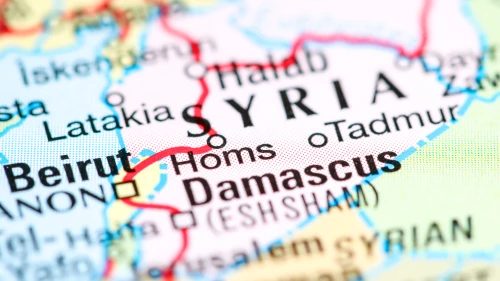
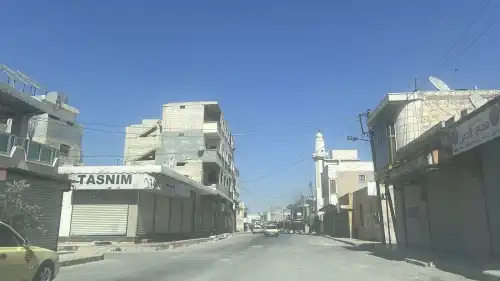
But not all the localities in Aleppo province affected by a Turkish military presence are Kurdish. Northeast of Aleppo city, in the area of al-Bab (which was once a stronghold of the Islamic State before Turkish-backed insurgents dislodged the group in an offensive in 2017), Turkey established a military base in a neighbourhood called Jabal Aqil. Despite the fall of the Assad regime, this base has not been removed. Recently, people from Jabal Aqil protested against this base and demanded a return to their homes. Below is an interview conducted on 16 May with Muhammad Qannas of the ‘Media Office for Jabal Aqil’ regarding the recent protests. It is slightly edited and condensed for clarity. Parenthetical insertions in square brackets are my own.
Q: Can you speak a little about Jabal Aqil? Its history during the revolution, why a Turkish military base was established in the area, and the injustice the people of Jabal Aqil have faced.
A: Sir, we—the people of Jabal Aqil—have lived on this hill for more than 300 years. In 1936, in the days of the French Mandate, delineation and liberation took place: i.e. recording of the real estate, land and houses in the name of each person. But by mistake, our homes were registered in the name of the Awqaf: i.e. they became a waqf.*
We are continuing in our demonstrations against the Turkish base until they either leave and give us back our homes or the state compensates us with another place.
The property and lands became a waqf without the knowledge of their people. And until 1980, the people were living there and did not know, until the Awqaf directorate came and told them that their houses and lands were registered in the name of the Awqaf. Problems arose in those days, and we remained as we were, and then in 1998, an exchange of the awqaf land took place: i.e. we paid money and the homes were registered in our names. And we remained as such until 2017 when the Turkish base came. The Turkish army came and since we were living on a high, elevated place, the Turkish army took the area, destroyed the homes with bulldozers and built a military base on it.
The military base continued to remain while we remained displaced from our homes. We asked for the military base to be removed from our homes but without a response. Until now, there are still some homes present where the Turks are residing, while the remainder have been bulldozed and turned into a military base.
We came out on demonstrations and continued to do so until the local council met before the liberation of Syria with the Turkish base. They gave us homes on the same Jabal [hill] on which they are residing but some distance away. They also gave us documentation of the real estate, each in the name of the person. We remained in this situation until around two months ago when the region director came to us and told us: ‘We are creating a university and university accommodation and investment projects’- in the same place where we are living as a replacement for our homes.
And we are still displaced between tents and farms: some of our homes are present in the base and some of them are destroyed, and no one has asked about us.
We are continuing in our demonstrations against the Turkish base until they either leave and give us back our homes or the state compensates us with another place in the form of homes or even land so we can build homes on them.

Q: Of course, in the recent period the Interior Ministry has issued new laws on organising demonstrations and obtaining permits for them. Did you have to take permission from the authorities to organise the demonstrations? How have the security forces dealt with the demonstrations? How do you also assess the local authorities’ responses to the demonstrations?
A: We heard of the Interior Ministry’s decisions but we did not take permission. The security forces were present at the demonstrations but they never interfered and did not speak with us. But the state did not at all respond to us. No one came to us and asked us what was wrong. The Turkish base summoned us and asked us what was up. We told them we are wronged since they are residing in our homes. They replied: ‘We are here by international decision.’ This is what happened with the Turkish forces. As for our state, it did not at all respond to us. No one came to us and asked: ‘What do you want?’ We are continuing with our demonstrations.
Q: As it seems there is an agreement between the Syrian state and Turkey for this base to remain. Was this base established because of the war against Daesh [Islamix State]? What are the justifications for this base to remain?
A: The Turkish base was established after the war against Daesh ended and Daesh was routed, and until now it is present, but the reason why it remains, we don’t know. We don’t know why it has remained after the war has ended. We are still present until now and demanding our rights.
Q: Recently has the regional administration conducted any dialogue with you to explain the situation or clarify when the Turks will leave?
A: With regards to the regional administration, around four months ago we met with the regional director and the Awqaf directorate and they told us to be patient and not go on demonstrations, telling us to wait two months and see the situation. We waited two months and after that we were still waiting and received no response from the regional administration, and then we were surprised that the regional director came to the land we were living on and told us they were going to build a university and investment projects etc., contravening all we had agreed on since 2021.
Until now there has been no reconstruction in our country, nor has there been any consideration of the children who are scattered about and have no education, residence, refuge, medical treatment.
The regional administration told us: ‘If you want to go on demonstrations, do so until the Turkish base is evacuated.’ As it seems, there is no agreement at all between the state and Turks regarding the bases because the Turkish base command told us they are there by ‘international decisions’ only. Anyway we know that the presence of the Turkish bases among us in Syria is illegitimate and not agreed upon with any official authority in Syria.
Q: What is your message to the Syrian state and likewise the Turks and likewise the international community?
A: We- the people of Jabal Aqil, comprising 500 families, scattered until now in tents and farms- direct a message to the head of state President Ahmad al-Sharaa: we are 500 scattered families among tents and farms while our homes are occupied by a Turkish base and the state does not ask about us at all.
And to the military base: your mission has ended in Syria, the war has ended. We hope you will evacuate so we can return, rebuild and inhabit our homes again, and so we can work together and return our children to school, and return and live an ordinary life again like the rest of people.
We direct a message to the UN, the international community and the civilised states: see the condition of people displaced after the war has ended. We have thousands of families displaced among tents and farms. Until now there has been no reconstruction in our country, nor has there been any consideration of the children who are scattered about and have no education, residence, refuge, medical treatment. We are in need of the most basic human rights and components of life. Until now we have children not registered with the state since we don’t have an address. We have unregistered children aged 7 and 10 who are not registered with the state, schools or any rights we can secure them.
*Waqf (pl. Awqaf) is an Islamic charitable endowment. In this context, it would mean state land to be used for religious purposes (e.g. building a mosque).
Published originally on May 20, 2026.