

While some observers believe President Donald Trump is delaying a military strike on Iran to allow time to reinforce air defenses for U.S. bases and Israel, a central question remains: Can Tehran mount any meaningful attack against the Abraham Lincoln carrier group operating in the region?
Iran possesses thousands of one-way attack drones, along with anti-ship ballistic missiles and cruise missiles that could pose a serious threat if they were more technologically advanced and supported by reliable targeting systems.
A U.S. carrier strike group operating in the Indian Ocean or the Sea of Oman under emissions control, often described as “dark mode,” presents one of the most difficult targeting challenges in modern warfare. Much of the public discussion about Iran’s anti-ship capabilities underestimates how demanding the maritime kill chain is against a maneuvering naval force deliberately trying to remain hard to find.
Iran possesses thousands of one-way attack drones, along with anti-ship ballistic missiles and cruise missiles that could pose a serious threat if they were more technologically advanced.
To strike an aircraft carrier at sea, Iran would need to detect the force, identify it correctly, maintain a continuous track of its course and speed, generate targeting data accurate enough to guide a weapon to a moving target, and overcome layered defenses that include electronic warfare, decoys, and missile interceptors. Failure at any stage renders the attack ineffective.
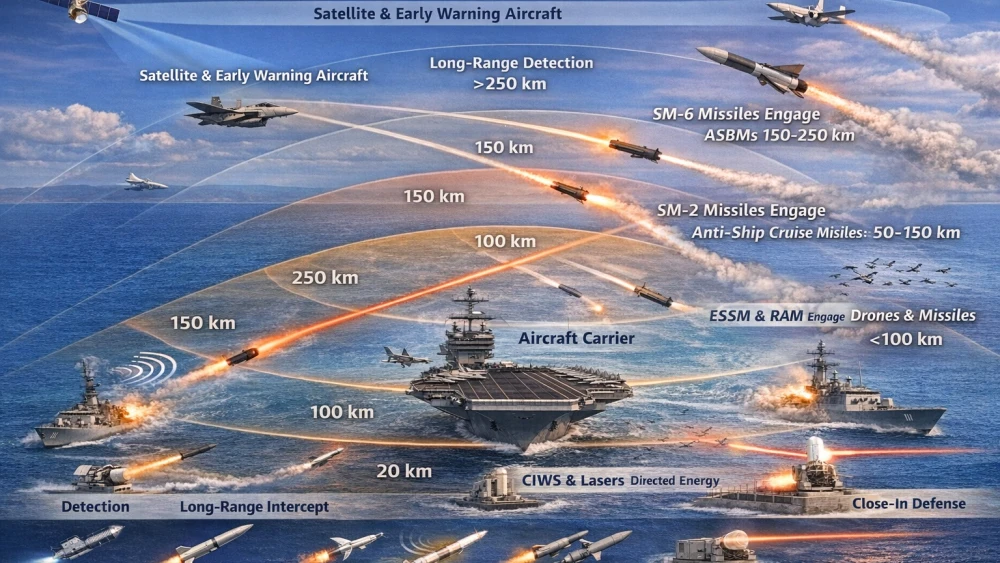
Iran does possess wide-area maritime awareness tools, including coastal and over-the-horizon radar systems, unmanned aerial vehicles equipped with electro-optical sensors, and intermittent space-based observation. These capabilities can indicate that U.S. naval forces are operating in a general area. They are poorly suited, however, to maintaining a precise and continuous track on a specific carrier strike group hundreds of kilometers from shore, especially when that group is minimizing radar and communications emissions and maneuvering unpredictably.
This limitation is decisive when assessing the threat posed by Iranian attack drones. One-way drones rely mainly on inertial navigation systems, sometimes supplemented by satellite updates, and are programmed before launch. Such guidance works against fixed or predictable targets but is largely irrelevant against a moving carrier. By the time a drone reaches the projected area, the target may have moved tens of kilometers. These drones lack autonomous target recognition suitable for naval combat and cannot search for, identify, and select a carrier independently. Launching them in large numbers, even several hundred at once, does not solve the targeting problem; it merely increases the number of objects that defensive systems can track and intercept.
Against a carrier strike group, drone swarms function primarily as harassment and posturing tools, though they remain far more dangerous to merchant shipping and fixed coastal infrastructure.
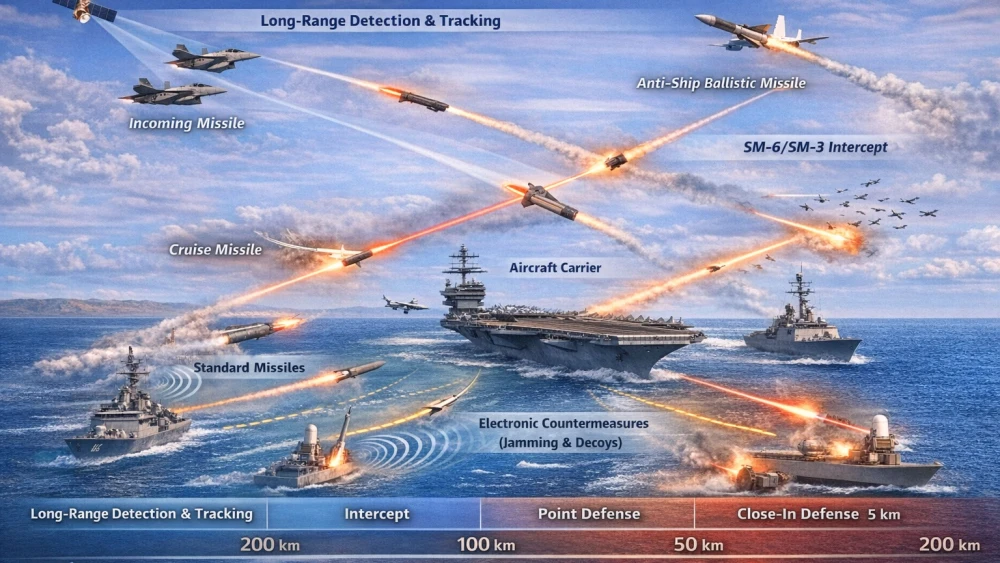
Anti-ship ballistic missiles represent a more serious capability, but they are also frequently misunderstood. Iran has adapted short- and medium-range ballistic missile designs for use against ships, and these systems are often portrayed as “carrier killers.” In practice, their effectiveness depends far less on the missile itself than on the quality of targeting data available throughout the engagement. A ballistic missile launched using outdated or imprecise tracking information will arrive at the wrong location, regardless of how many missiles are fired.
Saturation tactics do not automatically compensate for this weakness. Saturation is effective only when multiple weapons converge on the correct target area. The challenge intensifies during the terminal phase, when a seeker must acquire the correct target in an environment saturated with electronic countermeasures, decoys, and multiple large radar returns from escort ships operating in close coordination. Carrier strike groups are designed specifically to complicate this phase through layered air and missile defenses and cooperative engagement among multiple vessels.
Saturation is effective only when multiple weapons converge on the correct target area.
The Sea of Oman further complicates the attacker’s task. Unlike confined maritime chokepoints, open waters give a carrier strike group room to maneuver, reduce predictability, and improve defensive cuing from airborne and space-based sensors. In this environment, Iranian anti-ship ballistic missiles pose a greater threat to slower, less-defended commercial vessels than to a U.S. carrier operating at standoff distance.
A common question is whether large drone swarms approaching the general direction of a carrier group could force warships to expend expensive interceptor missiles carried in finite numbers. In theory, such attacks could impose economic costs or raise concerns about magazine depletion if hundreds of drones were launched simultaneously. A U.S. destroyer, for example, carries fewer than ninety air-defense missiles.
An increasingly important factor in this equation, however, is the deployment of directed-energy defenses aboard modern warships. Several U.S. naval vessels now operate laser systems, and high-powered microwave weapons are being tested and introduced in limited roles. These systems are particularly effective against small drones, including swarms, because they allow rapid reengagement at far lower cost per interception than conventional missiles. While they do not replace defenses against ballistic or cruise missiles, they further reduce the value of drones as a saturation weapon.
Taken together, these factors suggest that Iran’s maritime strike capabilities are best understood as tools for coercion, disruption, and escalation management, rather than reliable means of defeating a carrier strike group at sea. Neither Iranian drones nor missiles can currently overcome the fundamental challenges of detecting, tracking, and accurately engaging a maneuvering carrier operating under emissions control in open waters.


