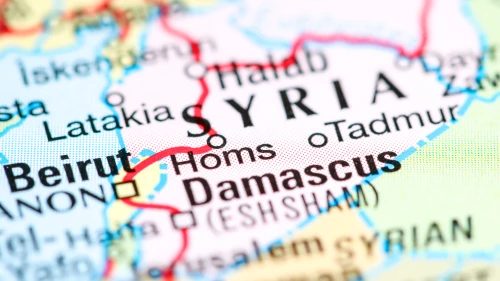
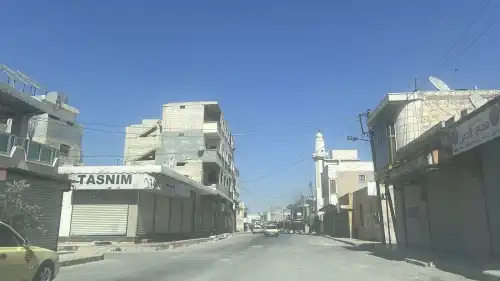
Most media coverage of the Druze in post-Assad Syria has focused on the primarily Druze province of Suwayda’ in south and the massacres committed against Druze communities there last summer by government forces and allied tribal militiamen. There is, however, a much smaller isolated Druze community in the Jabal al-Summaq region of north Idlib countryside, near the border with Turkey. Over many years, I documented the community’s experiences under al-Qaeda affiliate Jabhat al-Nusra and its successor entity Hay’at Tahrir al-Sham (HTS), including the experiences of forced conversions, the massacre in Qalb Lawze in 2015, confiscation of land and property of absentees, settlement of foreigners in the region, and some amends made by HTS to the community in the years just before the fall of the Assad regime in the form of restoring confiscated lands and property.
The authorities have requested that the house’s original owner should not be paid right now until the person living in the house should be compensated for what he has paid by being given a house in the concrete camps in the north.
Some 18 months since the fall of the Assad regime, what is the present situation of the Druze community in Idlib? What are the policies on religious freedom in comparison with the past? How are services and the humanitarian situation? And has the situation in al-Suwayda’ had any ramifications for the Druze of Jabal al-Summaq? Has the region witnessed recruitment of locals into the military and security forces? Below is an interview conducted on 3 June with Issam Ibrahim, a political and civil society activist of the Jabal al-Summaq village of Qalb Lawze. It is edited and condensed for clarity. Parenthetical insertions in square brackets are my own.
Q: Have the lands and houses of Druze in Jabal al-Summaq been restored to their original owners since the liberation? Have the landowners received compensation for the use of their land and profits made off it when it was confiscated?
A: All the lands have been returned, yes. As for houses, 90% have been returned as of this month. 10% have not been returned because of costs, whereby the house has been inhabited by a muhajir [foreigner who joined the insurgency] or displaced person who asks for compensation for costs he has paid for the house, despite not having paid rent during the time he has lived in the house. The authorities have requested that the house’s original owner should not be paid right now until the person living in the house should be compensated for what he has paid by being given a house in the concrete camps in the north, whose inhabitants have returned or will return to their original homes in Damascus, Homs, Hama countryside and south Idlib.
The authorities have not provided compensation for the profits during the time of inhabitation, except for a small part of the lands that had a special situation in that they came under state control.
Q: Have the authorities allowed you to return to your original religion?
A: Regarding the return to the original return, it has become a personal matter. There is no pressure on the people in this matter in terms of dress and customs, for previously in Jabal al-Summaq, not everyone was very religious, and society was characterised to a predominant extent by secularism and simple rural life, with many of the Islamic customs resembling those of our neighbours in Jabal al-Summaq.
The new Shari‘i officials have said that from the outset there was a mistake in the collective declaration of Islam in 2013, because entering Islam has to be through pronouncing the two shahadas [declarations of faith] by each person alone or with his family. They say that writing a statement and signing it by two people for each village was not a correct Shari‘i act.
Q: But the old shrines have not been rebuilt?
A: They have not been rebuilt, correct. I don’t think the people of Jabal al-Summaq desire to do so right now. They have chosen the option of the Islamic religion as a religion that brings together sects and not to distinguish themselves from their neighbours.
With regards to the issue of Islam and its declaration: the essence of the Monotheists’s [Druze] religion is Islam. They do not desire another name.
With regards to the issue of Islam and its declaration: the essence of the Monotheists’s [Druze] religion is Islam. They do not desire another name. This is what their religious authorities say, with the religion of the monotheists not being an independent religion. Rather they are an Arab sect of Islam who have special rituals as is the case with the Sufis, Mu‘tazilites and Naqshbandis. They do not like the term Druze, which is a nickname. Thus, when you ask any monotheist from the Bani Ma‘ruf [Druze] what his religion is, it is Isla. Therefore, the request to declare Islam is not abandonment of one religion for another. As for the thinking of some of the Salafi jihadists who follow the ideas of the shaykh of Islam Ibn Taymiyya, they consider the Druze and the Shi‘a to be the people of taqiyya [dissimulation] and innovation, not Islam. Islam has around 1.5 billion followers around the world. Are all of them Salafi jihadists, or are there different sects of Islam spread throughout the entire world?
Q: Are the new Shari‘is those who came after the liberation?
A: They came after the formation of the Salvation Government before the liberation and now they have become affiliated with the Awqaf Ministry.
There is a point I must add: among the people of Jabal al-Summaq are those who have travelled to Lebanon or are outside Syria since the Islamic factions seized the north. Those who have remained have chosen to live on their land and in their homes and bear everything, because the ancestors of the people of Jabal al-Summaq have faced harsher and bloodier circumstances for 1000 years and at the time there was no media or anyone to transmit news of those events. Therefore they stuck to their land and homes because they consider this Jabal [mountain] blessed. They love to work the land, and if they die in their land it is a matter considered to be God’s judgement.
Q: How has the services and humanitarian situation in Jabal al-Summaq changed in recent years, for example in terms of water and electricity?
A: Jabal al-Summaq was very neglected in the days of the deposed regime. With the beginning of the revolution also, there was no water, electricity, Internet or even mobile networks, because many of these things went out of service, were stolen or were bombed. But around the start of 2022 more or less, we began to notice a growing interest in general on the part of the Salvation Government and some NGOs. A Turkish electricity supply company was brought here as happened in the other regions of Idlib, and some humanitarian NGOs offered some services. Currently, following the liberation, the situation is better, but the Jabal still needs a lot more in terms of offering medical and educational services and also the roads need to be improved. Most of the inhabitants need job opportunities like opening factories or tailoring workshops to employ the women and job opportunities for the youth so that they do not choose to migrate, for life in general is harsh here despite the natural beauty and calm nature of the place.
Q: What are the main challenges in terms of the services and humanitarian situation?
Instances of harassment took place last year with the bloody July events between the Bedouin, Druze and government forces in Suwayda’ in which many innocents died.
A: The greatest challenge is the rough roads that are far from the towns, and the lack of support for education, healthcare and care for the elderly. There are many widows and elderly who have no one to support them. Many are asking now: ‘What benefit do I get from the increase in salaries when I don’t have income?’ The land on the Jabal only has a few olive and fig groves which bear fruit in one year and don’t in another. Last year there was drought and the olive season was weak, and the cost of extracting oil became very high in terms of transport and manual labour.
Q: Yes. Of course some of the people of Jabal al-Summaq were killed last year in the area of the village of Kafr Maris. Are they facing any harassment especially in light of the Suwayda’ events and the stirring up of sectarian strife?
A: Yes. This terrible event [the killings in Kafr Maris] took place and the perpetrator remains unidentified until now, and they say the investigation is ongoing. Instances of harassment took place last year with the bloody July events between the Bedouin, Druze and government forces in Suwayda’ in which many innocents died. The impact was through incitement on social media, but this year, until now, matters have become better, especially after the people of Jabal al-Summaq expressed their position on more than one occasion and their support for the government and Syria’s unity.
Q: For example can you go to the villages and towns and say you are from Jabal al-Summaq and one of the monotheists [Druze], and you won’t face harassment?
A: Yes. They normally ask you: aren’t you from Jabal al-Summaq? The proportion of the people of Jabal al-Summaq relative to the rest of the province’s inhabitants is very small. Many of the people of Jabal al-Summaq have preserved strong links with their neighbours despite the difficult circumstances. This is the main reason they have remained until now. In addition, they were not biased to the regime in the way that the inhabitants of Kafariya and al-Fu‘a [two Idlib Shi‘a villages] were, leading to their displacement.
Q: What are your feelings towards the massacres that happened in Suwayda’? Do you hold the government responsible for what happened?
A: My expectations are that matters Suwayda’ are not heading to resolution. There are those who protect Suwayda’: the blue [Israel]. As for us, we regrettably have no one to protect us. We have been very impacted and saddened by what happened in Suwayda’ since we have civilian relatives who died there. Yes, we hold the state responsible in terms of individuals from it who have done harm to the state by these actions, affected national unity and caused a wound.
My expectations are that matters Suwayda’ are not heading to resolution. There are those who protect Suwayda’: the blue [Israel]. As for us, we regrettably have no one to protect us.
Q: In all truth do some of the people of Jabal al-Summaq sympathise with Hijri and the ‘Bashan’ project?
A: They have relatives there, and want matters to return to normality. The monotheist Druze don’t like anyone attacking them. As for the Bashan project and a state independent of Syria, the people of Jabal al-Summaq do not prefer this solution because they know what happened with the inhabitants of the Golan and how they ended up in another state.
Q: Layth al-Balous visited Jabal al-Summaq. How did you benefit from his visit?
A: Yes, he visited us twice after the liberation. Balous is a personality who was revolutionary against the Assad regime, but after the Suwayda’ events of July 2025, matters changed and he has become a personality with the Syrian government, striving to resolve the problems of Suwayda’, which I think are too big for him to solve alone, if there isn’t cooperation on the part of all, especially the educated and notables in Jabal al-Arab [Suwayda’]. The people of Jabal al-Summaq welcomed him as a Syrian foremost, and he met with a number of notables in Kaftin, Qalb Lawze and Kukku. There are those who asked him to deliver some messages to the government in terms of recruiting people of the Jabal into the Defence Ministry and also to show interest in the Jabal. No personality should be given what is too big for him to handle.
Q: Has there actually been an opportunity among you for recruitment into the army and security forces?
A: Yes. Firstly, some personnel who defected from the regime at the start of the revolution have been returned to their positions. Then a small number have been taken to join the security apparatuses, police and border guards.
Q: What is the number of recruits approximately?
A: I don’t have a precise survey, but I think only around 10 from each village as new personnel.
Q: 10 people from each village?
A: Yes, or less, because some villages are very small.
It is a mountainous area inhabited by monotheist Druze for hundreds of years and they have faced many difficult circumstances and received thousands of displaced Syrians from Syria’s regions.
Q: Have the muhajirin left all the villages in Jabal al-Summaq? Or for example are there some Uzbeks in Kaftin?
A: In every two villages there remains one or two houses, not always inhabited: i.e. they come and go, and these are of the houses I told you about regarding material costs in terms of decor or furniture etc. Yes, there are still Uzbeks in Kaftin. I am not sure of their nationality, but I think Uzbeks or Tajiks.
Q: Finally what is your message to the international community about the situation in Jabal al-Summaq?
A: Jabal al-Summaq is an area in need of care and interest because it could become a tourist area on account of its natural beauty and ancient ruins. It is a mountainous area inhabited by monotheist Druze for hundreds of years and they have faced many difficult circumstances and received thousands of displaced Syrians from Syria’s regions. They are a generous and brave people and love guests and, after the liberation, they hope Syria will be unified and free and that Syrians will live a life without wars and sectarianism and good and peace will spread after lean years.
Published originally on June 3, 2026.