Of the various armed groups in Gaza that are opposed to Hamas and receive backing from Israel, the ‘Popular Forces’ is by far the most prominent. Initially founded by Yaser Abu Shabab who was killed in December last year, the group is presently led by Ghassan Duhine, who effectively served as Yaser’s deputy. It is also known as the ‘Counterterrorism Service.’
In this exclusive, lengthy interview with Ghassan, we discuss his group’s history, its efforts against Hamas, relations with Israel and Ghassan’s own very interesting background and outlook. What is his connection to Salafi jihadism? Is he linked to the Islamic State as some reports have claimed? Did he have such links in the past? And what is his connection to Syria? How does he view the Palestinian Authority and the two-state solution? Find out all these details and more in the interview below, which is edited and condensed for clarity. Parenthetical insertions in square brackets are my own.

Q: First, when was the Popular Forces formed and what were the reasons for its formation? Are most of its members from a specific tribe for example?
A: The Popular Forces was initiated in March 2025. It was a small force composed of people from Rafah and specifically east Rafah. They refused to leave their areas when people were displaced, and hundreds of civilians and military personnel in the [Gaza] Strip after we announced the establishment of a safe zone and that we would strive to prevent Hamas from bringing fire to our areas that Hamas got involved in a mad, stupid war.
Q: Does the Popular Forces receive support from Israel as some say?
A: There is cooperation between us and the Israelis as in other aspects of life in Gaza where international associations and businessmen coordinate [with the Israelis]. Everything in Gaza requires coordination on the part of Israel so that life can go on successfully. For we escaped and the bombing in our areas ended and this was the result of a video recording I published with my voice and face whereby I asked the world to adopt our ideas in giving us a second choice such that we would be separated from Hamas’ monopolisation of decision-making. And so Israel responded to us as did other international actors, and they have helped us endure in very good circumstances. Natural relations have arisen between us and the Israelis in any case, for the decision to go to war lies with them. Anyway, 80% of our people did not agree to this war even if they ended up getting involved it.
Q: Could you give us a summary picture of your life? Some say you were affiliated with the ‘Jaysh al-Islam; faction in Gaza. What’s your response to that?
There is cooperation between us and the Israelis as in other aspects of life in Gaza where international associations and businessmen coordinate [with the Israelis].
A: I am Ghassan Abd al-Aziz al-Duhine. I was born on 3 October 1987 in the city of Amman in Jordan and I returned to the homeland after the Oslo agreement. I graduated from the Dar al-Hadith institute for Shari‘i Sciences and worked in the training branch of the Palestinian National Security Apparatus. I adopted Salafi thought and embrace it, and I memorised the Qur’an and texts of Shari‘i knowledge that explain jurisprudence and creed. I am married and have three children: Awab, Maryam and Walid. I live in east Rafah until now.
Q: Currently in which areas does the Popular Forces operate and wha are its main activities besides combating the Hamas movement?
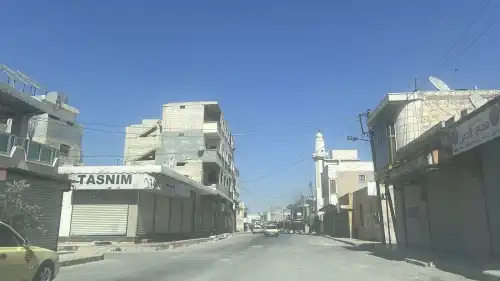
A: The Popular Forces operates in all of Rafah and all the areas behind the yellow line in every sector. Besides combating the Hamas movement, the Popular Forces establishes schools. I visited one of them recently and this was publicised. Likewise the Popular Forces is building clinics, and we are beginning to build a big and excellent hospital that can accommodate large numbers of people, as well as establishing temporary, air-conditioned and equipped housing. We publicised this at the time. We also offer shopping services with very normal prices and provide job opportunities in the military and civilian realms in accordance with the principles of international law, with a minimum wage of 3000 shekels for a person. We also publicised this at the time.
Q: What are the Popular Forces’ priorities at this time?
A: The priority now and at all times is to show concern for people and their needs, and this is not connected to or in contradiction with the presence or withdrawal of the Popular Forces.
Q: What were the circumstances of the martyrdom of the leader Yaser Abu Shabab?
A: Yaser was martyred because of his intervention in resolving a problem between the al-Dabari and Abu Sanima families. In this, he- may God have mercy on him- did not follow the conditions of security and public safety. His martyrdom did no affect the Popular Forces because we have established a decentralised system that is institutionalised to some extent. So as you see, the Popular Forces have become far more advanced than they were before, praise be to God.
Q: In the long-run what are your aims? Does the Popular Forces support the two-state solution?
A: We support any solution that satisfies both parties and ends the long decades of continual violence with a bold peace process that ends all this madness.
Q: What is your position on the war between Israel and the U.S. on one side and Iran on the other?
A: We support Israel’s right to self-defence against this threat that has shown that it truly cannot be trusted as a good neighbour since the Iranians bombed all the neighbouring states. We support America’s right as a great power to prevent Iran from committing the crime of obtaining nuclear weapons. For the one who uses the Kalashnikov rifle as a means of suppressing his people will not hesitate to use nuclear weapons against others.
Q: Could I ask as a follow-up: were you affiliated with the Jaysh al-Islam faction as some claim?
A: During the period when I adopted Salafi jihadism, it is true I affiliated with a faction that was close to Jabhat al-Nusra during the war in Syria, but not Jaysh al-Islam specifically. However, at the time we were in one boat with the Palestinian Jaysh al-Islam group.
Q: And later on you abandoned this.
A: Abandoned what?
Q: I mean you abandoned Salafi jihadist ideology.
Salafism serves as a personal identity without projections. I as Ghassan pray as a Salafi in terms of jurisprudence. My friends are Jews. Collective action differs from personal orientation.
A: Salafism, no. Jihadism, yes. Peace is truth and truth is more worthy of being followed. The Salafis like the people of Saudi Arabia do not negate the other or hate the other. Rather, Salafism serves as a personal identity without projections. I as Ghassan pray as a Salafi in terms of jurisprudence. My friends are Jews. Collective action differs from personal orientation. I don’t call on anyone to act like me. It is not right for me to say that I should not mix with anyone who has not memorised the book [Qur’an]. The fact that I have memorised it does not mean that I am superior to someone else because of it. There is no need for me to disseminate my orientation. I send regards to people for every occasion they celebrate- and by every I mean every. Do you think the one who has established good neighbourly relations with his Jewish neighbours will choke by sending regards to non-Muslims? Religion and jurisprudential orientation have nothing to do with public action. My support for Jabhat al-Nusra during the war was due to the photos of children who were photographed being killed. All the free world condemned that at the time and imposed sanctions on al-Assad. I was among this collective that took this position. The same sort of thinking lies behind my coming out to fight the oppressive Hamas: protecting our decision-making by refusing to let them apply their actions, path and oppression to us.
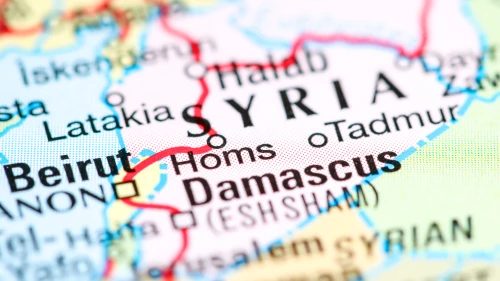
Q: I live in Syria. How do you assess the new Syrian government?
A: There is good in the new government and it needs time. I will send a message to Abu Muhammad [Ahmad al-Sharaa, the president]. I call on him to preserve good relations with neighbours and not let the people of incitement and false claims ruin your life in this world for the sake of a cause that has not been harmed by anyone more than those who have claimed to support it. The cause of supporting Gaza will be realised when the Syrian peace experiment succeeds. Do not let the opportunities slip in the face of those who do not want good for you.
Q: In my view there was a mistake in how the Israelis dealt with the matter. If I had been in Israel’s place, I would have made a security agreement with Syria as a basis for future negotiations.
A: If Israel had not done what it did, no one would have trusted it. Israel has an orientation whereby it will stand with those who ally with it. Wasn’t the mistake when the government was drawn by the whims of my Bedouin cousins? Did you really need to make the Druze feel alarmed about you? Didn’t the son of the Shaykh of Karama [Layth al-Balous] deceive you in claiming to represent the Druze? It is right for [Hikmat] al-Hijri to be the one leading his people. What’s done is done. Do not obey every arrogant fool. The Bedouins see it as a tribal war. Do not let the opportunities slip and make the Druze and others besides them love your experiment. In minutes you did what the stupid regime feared to do.
Q: With regards to the Druze the Israeli policy is understandable. They want to protect the Druze. The government’s policies in this matter were mistaken, but I meant the mistakes were in the areas of Qunayra and Deraa and making a security agreement.
A: You have an opportunity for development. Do not follow multiple paths. Neutralise every hostility that does not benefit you. You must deal with the matter of the Druze with wisdom. Perhaps you are much better than others. There is no doubt about the wisdom of those who built a force in Idlib with all patience until the time came for them to arrive in al-Sham [Sham]. With all my heart I wish for them to be helped, not for their sake but yours. You should help them and do not make those whom God guided to peace turn against them as happened previously in the Black Decade [Algerian civil war].
I have stuck to Rafah, where I have cracked down on tunnel after tunnel and cleansed them. I have vanquished some 200 terrorists who intended to harm us before the Israelis.
For example I do not leave Rafah, even if I am called to meetings outside it. I have stuck to Rafah, where I have cracked down on tunnel after tunnel and cleansed them. I have vanquished some 200 terrorists who intended to harm us before the Israelis. What will happen is one of two things: either we increase our numbers here and expand Rafah northwards in the direction of Khan Yunis, or the fighting returns, we bring back the people of Rafah in a selective way whereby we admit into our ranks those who are uninvolved [with Hamas], and from them also our army will be strengthened and we will eventually resolve the matter. By selective, I mean vetting and safe passages. 500 armed men constitute a division in a cause like ours.
Q: Can I ask what is your advice to the Palestinian Authority in the West Bank? For example some say that peace is impossible there because of the settler attacks on Palestinian lands in the West Bank.
A: The Authority is restricted. It has restricted itself with an ideology upon which it has raised people. It has neither remained upon this ideology and offered anything for it, nor will it succeed and achieve anything if it changes this ideology. Do you know why the Israelis and Americans liked us and do not see us as a burden upon them? Because they did not imagine the extent of our fighting capabilities in confronting what they call the al-Qassam elite troops. We would fight day and night, and we have one concern which is to prevent Hamas from returning, and we have succeeded. We do not deny the role of air support in some instances. We look to the experience of the Iraqis who liberated Mosul side-by-side with the Americans.
Q: As it seems the Palestinian Authority still promoes the idea that all of Israel will one day be replaced with Palestine: i.e. the Authority does not accept the idea of a Jewish state. Is this your reading too?
A: Literally so, in the framing of experts. Even the two-state solution doesn’t have what can support it right now. Realism is required.
Q: Is the best solution the two-state solution of a Jewish state and Arab state side-by-side?
A: What’s done is done. We need recovery. Who will give the defeated a state? The problem between us and Israel is that we are the ones who have least called for it and most harmed by it. The Arabs betrayed us from the beginning. They are the ones who told us our Jewish neighbour is an enemy and told us it would be shameful to accept dividing a country, most of whose lands did not belong to us. The Arabs ruled and occupied us before the Jews did. The West Bank was occupied by Jordan, which fled from it. Gaza was occupied by the Egyptian military regime and they fled from it too. They warned us against peace and yet they signed a peace treaty.
Q: And likewise the ideology of the ‘resistance axis’ has harmed the Palestinian cause, in that it calls for Israel’s elimination?
The solution is unconditional peace like our peace in Rafah, because the crisis between us and the Israelis is one of trust only.
A: The same mistake into which the stupid people have fallen. We are suffering from schizophrenia between Arabs and Palestinians! If I wanted to live as a Palestinian with the Israelis, this would be detrimental to my lame, weak Arab depth. If I wanted to live as an Arab [with the Israelis], I would find myself the tip of a spear in a conflict also called the Arab-Israeli conflict. The solution is unconditional peace like our peace in Rafah, because the crisis between us and the Israelis is one of trust only. We did not trust each other. Here we have overcome that. Our children see the tanks defending them against those who blew up in our midst the kindergarten in east Rafah, like the people of al-Quds [Jerusalem] when the Iron Done defends them so that a missile does not fall on them, and like the people of Beersheva when they respond to the Israeli Interior Front’s counsels to stay in the shelters. I have put to you three kinds of Palestinians: Rafah, al-Quds, Beersheva. This is the reality. The problem lies in those who have been addicted to fantasies.
Published originally on May 16, 2026.