In a previous post, I reported on the Kurdish village of Cilbirê as a locality in the Afrin region that lies in ruins and to which its original inhabitants are barred from returning on account of the presence of a Turkish military base.
Unfortunately, it is not the only case of its sort in the Afrin region.
A post in late April by the Syrian government’s ‘Afrin Region’ administration (see below) reported that the head of the Afrin region- Khayro al-Dawud- met with people from six Kurdish villages of the southeast Afrin region (just northwest of the Shia town of Nubl), including Cilbirê, discussing issues of services and infrastructure but also means of ‘facilitating the return of the inhabitants to their villages.’ This included discussion about ‘clearing military bases from some of the villages’ in order to facilitate returns.

In other words, the post acknowledged that the inhabitants of some of the villages are barred from returning because of a military presence of some kind. Cilbirê is one of them. Four of the other villages named are places I have been to, and I can confirm that Kurdish inhabitants are living in them and that the inhabitants are not barred from returning. The other case that is similar to that of Cilbirê is Basilê.
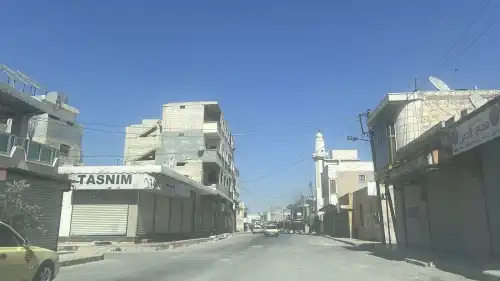
However, whereas one can at least pass through Cilbirê in order to go to another locale, this is not the case with Basilê. While driving in the area recently, I wanted to see if I could at least pass through Basilê in order to go to Soxanekê (which lies to Basilê’s southwest). However, as I entered Basilê (which, like Cilbirê, is largely if not entirely in ruins), I was approached by a Syrian army soldier who confirmed to me that the locale is a “military zone” and I would have to find an alternative route. Below are some photos I took.


Unlike Cilbirê, it does not appear that there is a military base built over destroyed houses inside the village itself, at least from what I could see. However, an examination of Google Earth imagery from prior to and after the invasion of the Afrin region by Turkish-backed factions in 2018 shows that some sort of facility has been built not far west of Basilê (called by its alternative name Basselhâya on Google Maps/Earth). It looks to have been built over the course of late 2022 and early 2023. Specifically, observe the location of ‘The Martyr Basil Arab Mosque’ on the left in each image. It seems likely that this is a military base used by Turkey and/or the Syrian government.


Again, as with the case of Cilbirê, I do not mention this issue with an aim to embarassing Turkey or the Syrian government, but rather just to highlight the cases where Kurds still cannot return to their villages. I simply hope that the military presence in Basilê will be removed in due course and the place will no longer be classified as a military zone so that its inhabitants can return and rebuild their homes.
Published originally on May 22, 2026.