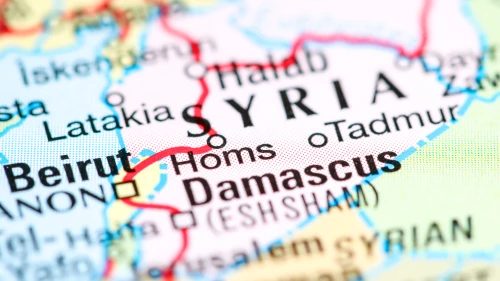
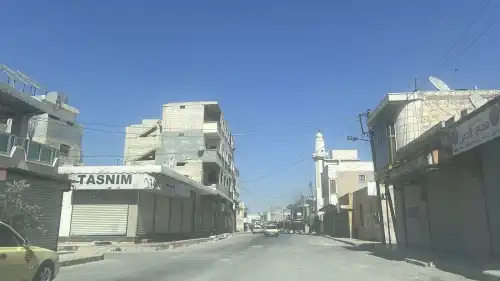
Yesterday, a video emerged of some Israeli settler activists who seek to colonise ‘Bashan’ (i.e. southern Syria) and had reportedly crossed into the area of Hadr— a Druze locality in Qunaytra province that lies opposite the Druze town of Majdal Shams in the Israeli-controlled Golan Heights. In keeping with their prior policy of evicting these would-be-settlers, Israeli forces that have moved into Syrian territory beyond the Golan since the fall of the Assad regime subsequently removed them.
In keeping with their prior policy of evicting these would-be-settlers, Israeli forces that have moved into Syrian territory beyond the Golan since the fall of the Assad regime subsequently removed them.
How do locals in Hadr view these reported attempts at settlement and the Israeli presence in their area more generally? Their own stance on Israel is somewhat more complicated than that of Druze in al-Suwayda’ who are behind Hikmat al-Hijri and the notion of an Israeli-backed ‘Bashan Mountain’ autonomy/independence project. After all, for a number of years during the war (2012-2018), Hadr—as a regime-controlled locality—came into conflict with insurgents operating out of neighbouring localities, with some of those insurgents receiving Israeli backing.
Below is an interview conducted today with a resident of Hadr. He lost his daughter because of insurgent shelling of Hadr during the war and his brother—a member of Hezbollah—was assassinated by Israel in 2019. He offers a useful clarification on what actually happened with the would-be-settlers and the complexities behind Israel’s relations with the Druze of Hadr. The interview is edited and condensed for clarity and parenthetical insertions in square brackets are my own.
Q: What happened yesterday with the reported entry of Israeli settlers into Hadr?
A: This area [where the incident took place] is around 30km away from Hadr, and not actually in Hadr at all. This area is affiliated with occupied Majdal Shams. And those people who entered via the border only traversed around 50-100 metres, not more than this, in an area where there is a minefield from the time of the former regime. We would not enter this area. Of course their government allowed them to enter because it is impossible to get through the gates against the [Israeli] army’s will. So there is an agreement. It’s a provocation—I don’t know. They entered, danced, sang and left. There were patrols with them. That’s it and it didn’t deserve attention. But the name Hadr spread as though it took place on Hadr’s periphery, even though Hadr’s periphery is 30 km away!
They did not enter Hadr’s lands. I don’t know if you know the area well. There is a platform on which the people [of Hadr and Majdal Shams] would celebrate on independence day where they would speak to each other with megaphones. A little behind it there are houses that belong to people from Majdal Shams who do not come from the occupied lands. That is, during the [1967] war, there were people who remained in Syria and other people who were confined to the town of Majdal Shams. So they are originally from Majdal Shams but they live here in Syria in the regions of al-Sham [Damascus] and in Jaramana but they came and built these homes that you saw. This completely belongs to Majdal Shams and these homes are not part of Hadr at all and are far away from Hadr.
Q: How do the Israeli forces deal with the people of Hadr? There is talk for example about Israel distributing aid and being an ally of the Druze. What do you think of this talk?
They entered, danced, sang and left. There were patrols with them. That’s it and it didn’t deserve attention.
A: Brother Aymenn, you know my opinion for some time. The reality on the ground after the fall of the regime and the terrorist government that has received authority is that whenever something strange happens in Qunaytra province in Jabal al-Shaykh and in Deraa, the government issues no statement or condemnation or anything about the matter. As I see things, the two sides [Israel and the new government] are in agreement, where the government says: ‘You take what you want, but leave us in power.’ You know Hadr’s position: we were being attacked by the people of this government in the time of the former regime. Who supported them? We resisted them and they couldn’t enter Hadr. Today by God they [the Israelis] say: ‘By God, this is a terrorist president.’ You are the ones who brought him to power and you acknowledge you brought him to power. As for the aid, it is being distributed in the areas of Qunaytra and Deraa, and not just in the Druze areas. There are weak-minded people among us who take the food aid, clothes and other forms of aid, and there is distribution like in all other areas. There are also armed groups affiliated with Israel like the Fursan al-Jowlan Brigade, which has long existed and was affiliated with Israel and is until now present in the southern area of Jubatha al-Khashab. The oven that Israel built in Jubatha al-Khashab is still operating. And every now and then the Israelis carry out raids whether in Hadr or other areas. We have ten people who have been arrested and we don’t know the reasons why.
To be clearer with you: no one is happy and we all expect the situation will be bad. but regrettably you cannot rely on the state because the state is happy if Israel takes the people of the Golan (who for 50 years rejected Israeli identity but now 90 percent of these people have turned a corner) effectively saying: ‘We don’t want them. Come and take the Druze who are in Syria with them’—a sectarian framing. Previously we had the Syrian state as our ally. Today we have no ally. We have to defend ourselves and protect our land, and you saw what happened in al-Suwayda’. We are ready to ally with whoever can protect us, but what we see is that there is some kind of agreement [between Israel and the Syrian government]. We are not the cause of it but they [supporters of the Syrian government] hold us responsible for it. I tell you: we cannot co-exist with this government that committed massacres on the coast and in al-Suwayda’ and against the Kurds, and kidnapped women, and whose decisions we see, and which we see attacking peaceful demonstrations in al-Sham. What is apparent is that the foreign states or those that brought this government to power will not change anything until they take what they want and partition Syria.
Q: It is said that the people of Hadr are afraid of speaking out against the Israeli occupation, as though the Israeli army is imposing silence on the people of the area, so if someone speaks against Israel, the Israelis come and arrest them or summon them for interrogation. Is this true?
Of course the one who is rational should not respond in this way, so as not to provoke talk against him and his religion in general.
A: No, not necessarily. There are kids aged 14, 17 or 15 and they only think of food, drink, motorbikes, hashish and such things. They are a small group. They don’t know about politics and they don’t know about all the risks behind this issue. They sometimes raise the Israeli flag, yes. For example, there is sometimes provocation from groups on Facebook affiliated with the [Syrian] state, saying: these people are agents, these people are traitors, these are the ones who killed our people in Gaza. In general they hold all the Druze responsible. And so these kids engage in a reaction. Of course the one who is rational should not respond in this way, so as not to provoke talk against him and his religion in general. For when they act in this way, they bring about curses against us and so on.
As for Israel itself, there are many incidents that have happened in the area where we have expelled them and there have been threats against them, and they have not come near anyone. They do not dare come near anyone, especially because they very much are aware that Hadr was steadfast for ten years in the crisis despite all the attacks that took place and were supported by the Israelis, including photography of locations, bombing, information and medical aid etc. for the Dawaesh [Islamic State people] and [Jabhat] al-Nusra. So they dare not approach anyone, for they are very much aware there are men in Hadr. And so they try to win over the people by claiming: ‘We protect you from Sunni extremism.’
Q: Finally what is your message to the Syrian state?
A: My message is that it should act as a state and not as a sect or militia. We see that all the positions in the state are taken by people from Sharaa’s circle from Idlib. They don’t know what the routine of each province is: what it needs and what is lacks. They don’t know and they come and put mashaykh [shaykhs] in the institutions, courts and universities: the universities have become mosques, they are no longer universities for knowledge. We are heading backwards. so what message can you direct to this state that is taking you backwards: you feel the growth of sectarianism inside you and you become distant from your state because your state is not fair to you. I do not except it can do anything even if I were to direct a message to it.
We are heading backwards. so what message can you direct to this state that is taking you backwards: you feel the growth of sectarianism inside you and you become distant from your state because your state is not fair to you.
As for if it were actually a state that actually respected itself, firstly it would not have dissolved the army and lost all the sources of power it had. It could have left the army as it was while being able to hold to account the criminals it wanted to, leaving the rest of the people in place as the army. I do not know a state without army besides Syria. This is not an army that we have. In my view, this government and this president will be transitional figures who are seeking to cling to power. Everything they claimed to stand for to bring down Bashar al-Assad was a lie. Today we lack all the components of life we had in the days of the former regime. A new government has to be formed with a new president who is a nationalist and not sectarian. Only then can you direct a message to him.
Published originally on April 23, 2026.