

Republicans lost the House and the Senate on Tuesday. Democrats flipped seven Senate seats, Texas, Kansas, and Iowa among them, and the Associated Press counted the war with Iran and surging costs among the reasons. Curt Mills had called it. “I think first it’s the economy, stupid,” he told a Telegraph podcast on October 30. “And second, it’s the war, stupid.” Democrats would “clearly win the Senate,” he said then, and might take Kansas and Iowa. Mills, who is 36, is the executive director of The American Conservative, the magazine Pat Buchanan co-founded. In late October he said the election would be “a searing guilty verdict” on the administration’s conduct of the war. At 11:05 on election night he posted: “It is, the Iran War, stupid.” Forty minutes later: “If Republicans want to win in 2028: they should end the Iran War. Everyone knows it.”
What the right believes about America’s enemies was always going to be argued out before the next presidential nomination. That argument began on Tuesday night, and Mills is one of the people making it.
What Mills brings to it is an account of who the adversary is. In March 2020, in a post he later deleted, he wrote that what the West did after September 11 was “a heinous overreaction” to what was, “effectively, a lucky shot.” In July 2025 he wrote that “the Congressional GOP is infinitely more dangerous than Zohran Mamdani.” The first sentence makes an enemy smaller. The second makes the fault of his own side larger. Mamdani is now the mayor of New York, and the Congressional GOP has lost both houses.
Some on the left had already found him. On the evening of May 22, the man who wrote both took a stage at Busboys and Poets, a café and bookstore in Washington, at a forum his own magazine had joined as a partner with Mehdi Hasan’s Zeteo and the Quincy Institute. He called the Iran war “the most unpopular war in American history.” The moderator, Wajahat Ali, told the audience: “You can applaud that.” He had already told Mills, “I have retweeted you without realizing who you are.”
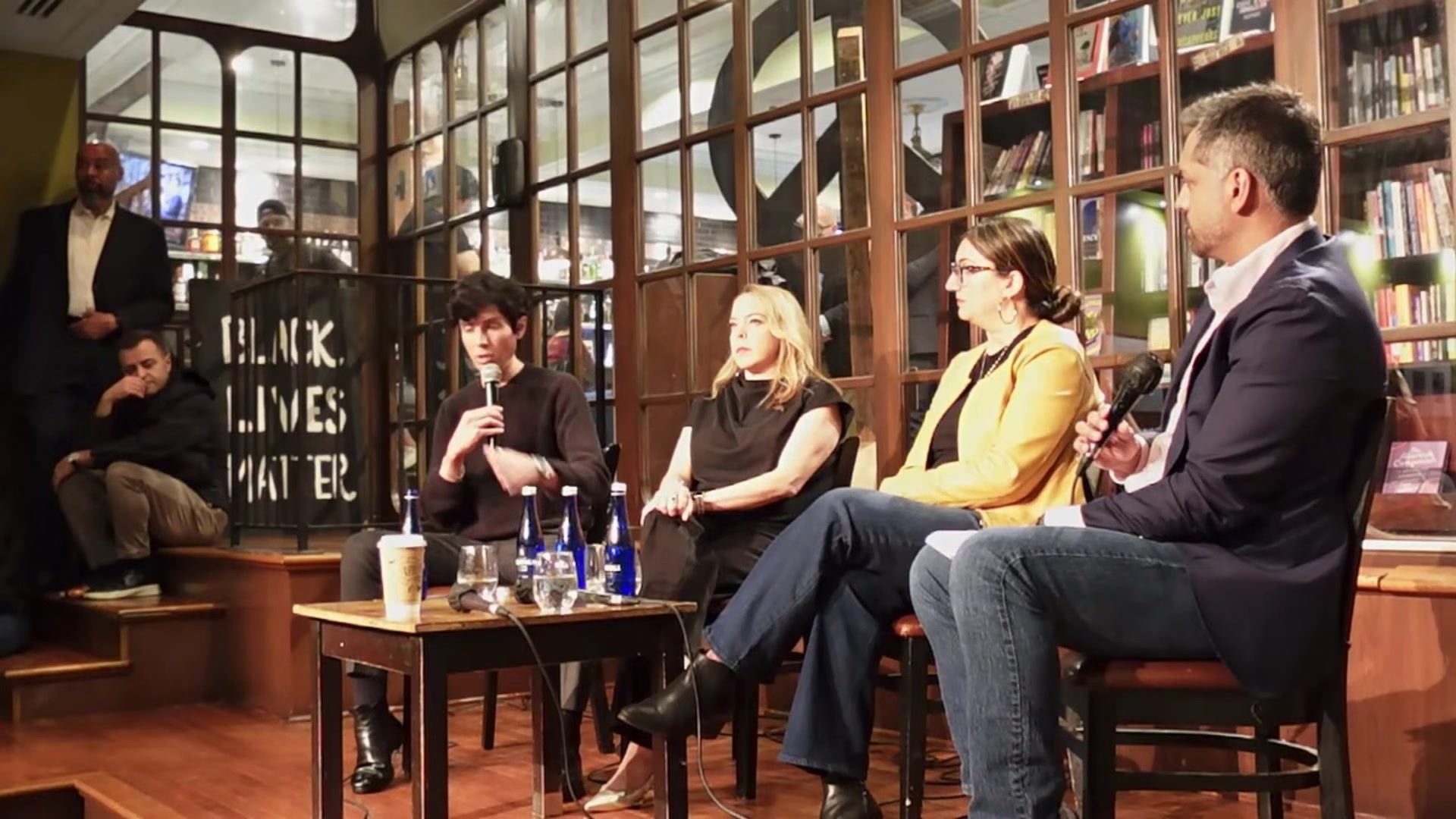
Curt Mills (left, holding microphone) on the first panel of “How to Prevent Another Forever War in the Middle East,” Busboys and Poets, Washington, May 22, 2026. Still from the event video, Busboys and Poets, YouTube.
Mills has run the magazine since January 2024. He was 11 and living in the Washington suburbs when the September 11 attacks, by the Washington Post’s account, pushed him to the right, and he has said the Iraq War was his political awakening.
The magazine is small. Its reach is not. By the Middle East Forum’s count Mills has appeared on Steve Bannon’s War Room on more than 60 separate days since April 2024, 38 of them this year. It is the program the president’s most loyal voters watch, and the words quoted here are his, not the host’s. He said in October that his magazine is “the only conservative institution in Washington DC against the Iran war openly.” His closest tie is to Tucker Carlson, who sits on the magazine’s advisory board and whom the left-wing magazine Jewish Currents, whose reporter spent several months getting to know Mills, calls his friend and mentor. “If there have been guardrails on this administration in its worst moments,” Mills told that reporter, “it is because Trump is not exclusively surrounded by neocon imbeciles. There are cadres of younger people who are readers of The American Conservative.”
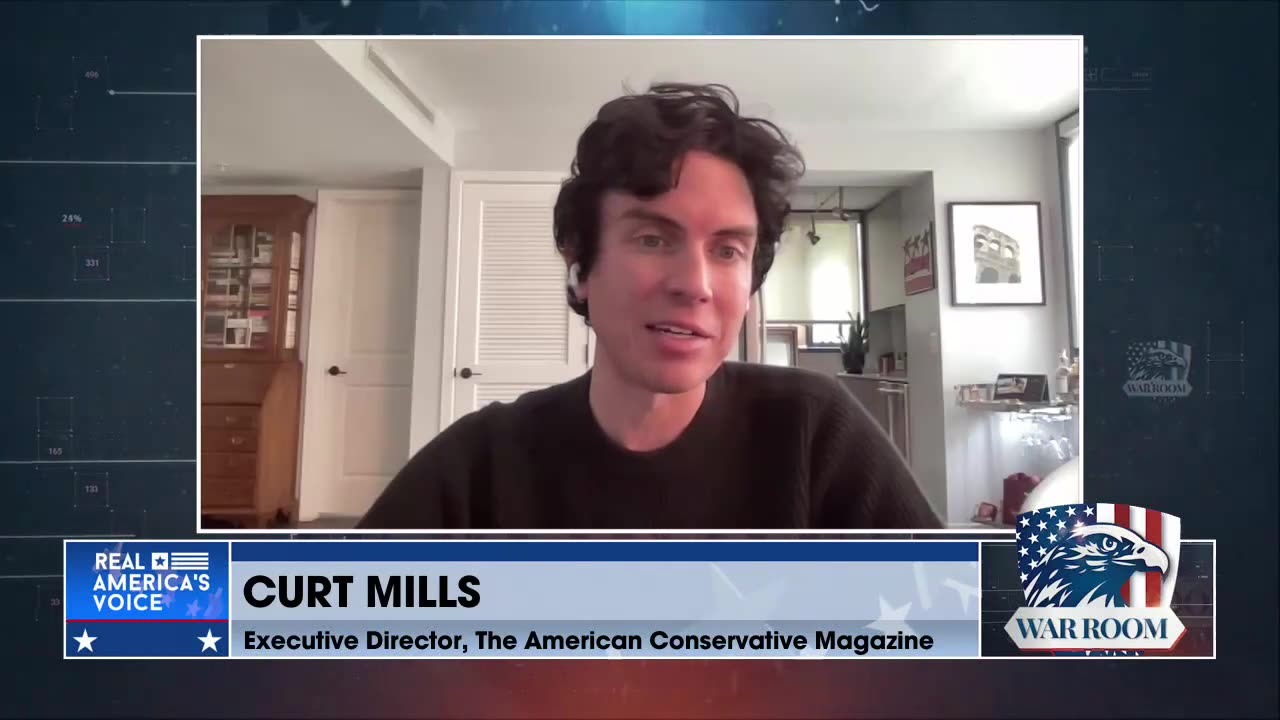
Mills on Steve Bannon’s War Room, July 11, 2026. Still, Bannon’s War Room, Rumble.
The account Mills gives of American power in the Middle East and Europe, that its uses of force are crimes, that its alliances are provocations and that its enemies’ violence is the consequence of its own conduct, is the account the American left has given since Vietnam. He has carried that account into the conservative movement. He has also carried a conservative signature back out to the left, which could not have supplied it for itself.
The dividing line runs inside the right, not between right and left. Conservatives have always argued about means: which wars to fight, how much the allies should carry, whether Congress decides. Taft did. So did Buchanan. So did Mills that night at Busboys and Poets. What is at issue here is a different kind of claim, a judgment about America and its enemies: that September 11 was luck, that the militias who killed American soldiers were plucky, that Iranian plots on American soil are America’s doing, that the outcry over Russian soldiers’ massacre of Ukrainian civilians at Bucha was a propaganda ploy, that American power abroad is an illegitimate empire. The first kind of claim is restraint; the second is something else.
The quotations that follow are drawn from an archive the Forum assembled of his public record since 2009: more than 450 recorded appearances, 1,269 articles, and about 19,000 posts. Deleted posts are linked to the Internet Archive’s copies.
The Tradition at Issue
In early 1951, General Dwight D. Eisenhower, about to take command of NATO’s forces in Europe, invited Senator Robert Taft to the Pentagon. Eisenhower had written out a statement that would rule him out of the 1952 race, and he would release it if Taft committed the Republican Party to collective security in Europe. Taft would not commit. Eisenhower tore up the statement, ran, won, and made the Republicans the party of NATO.
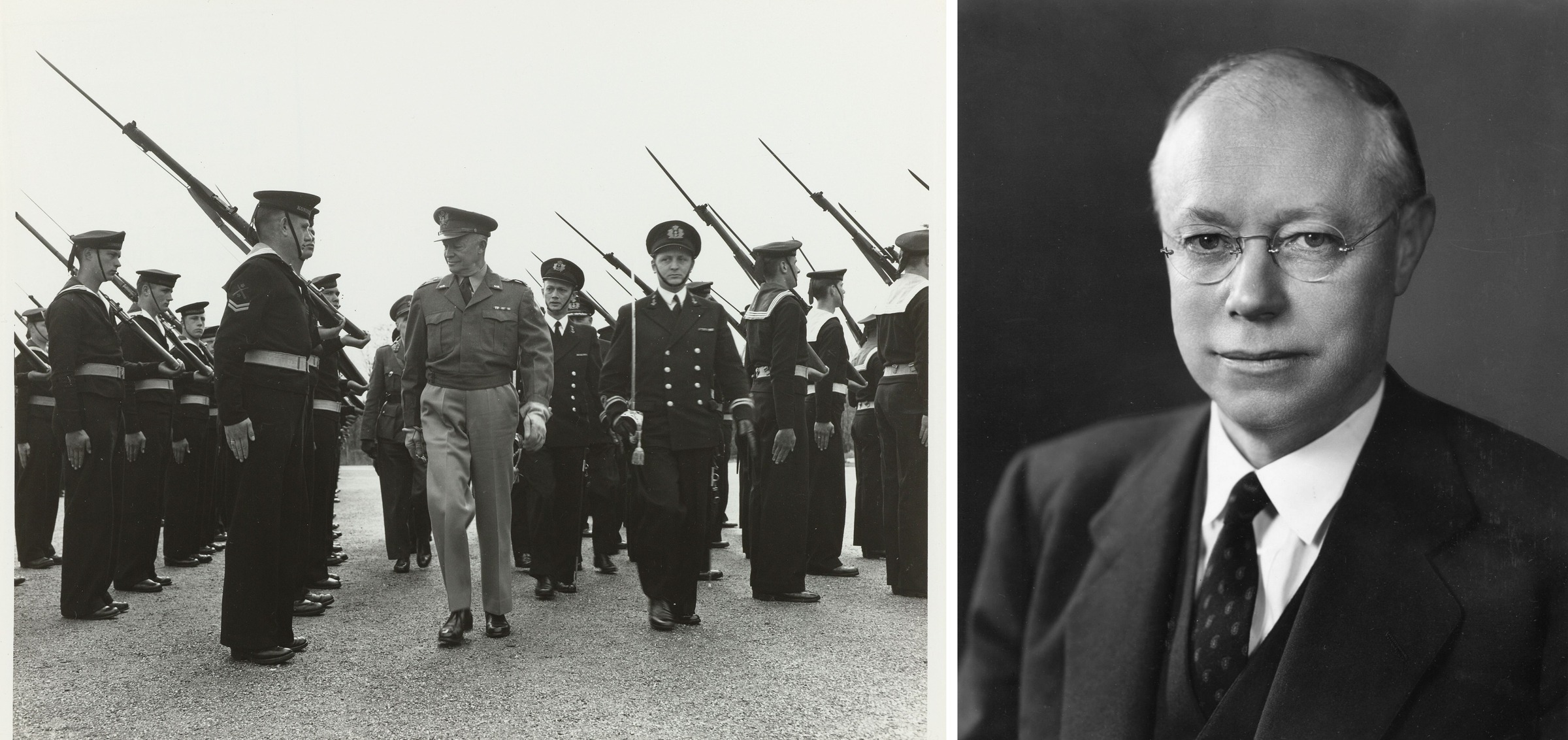
Left: General Dwight D. Eisenhower, NATO’s supreme commander, inspects Dutch naval personnel at Hilversum, May 1951. Right: Senator Robert A. Taft, 1953. Left: SHAPE photograph, Rijksmuseum. Right: U.S. Senate.
Ronald Reagan reduced the settlement of the Cold War to one sentence, which he gave Richard Allen in 1977: “We win and they lose.” Jeane Kirkpatrick, still a Democrat, explained to the 1984 Republican convention why she had crossed over. When Marines sent to Lebanon were murdered in their sleep, she said, the critics “didn’t blame the terrorists who murdered the Marines; they blamed the United States. But then, they always blame America first.”
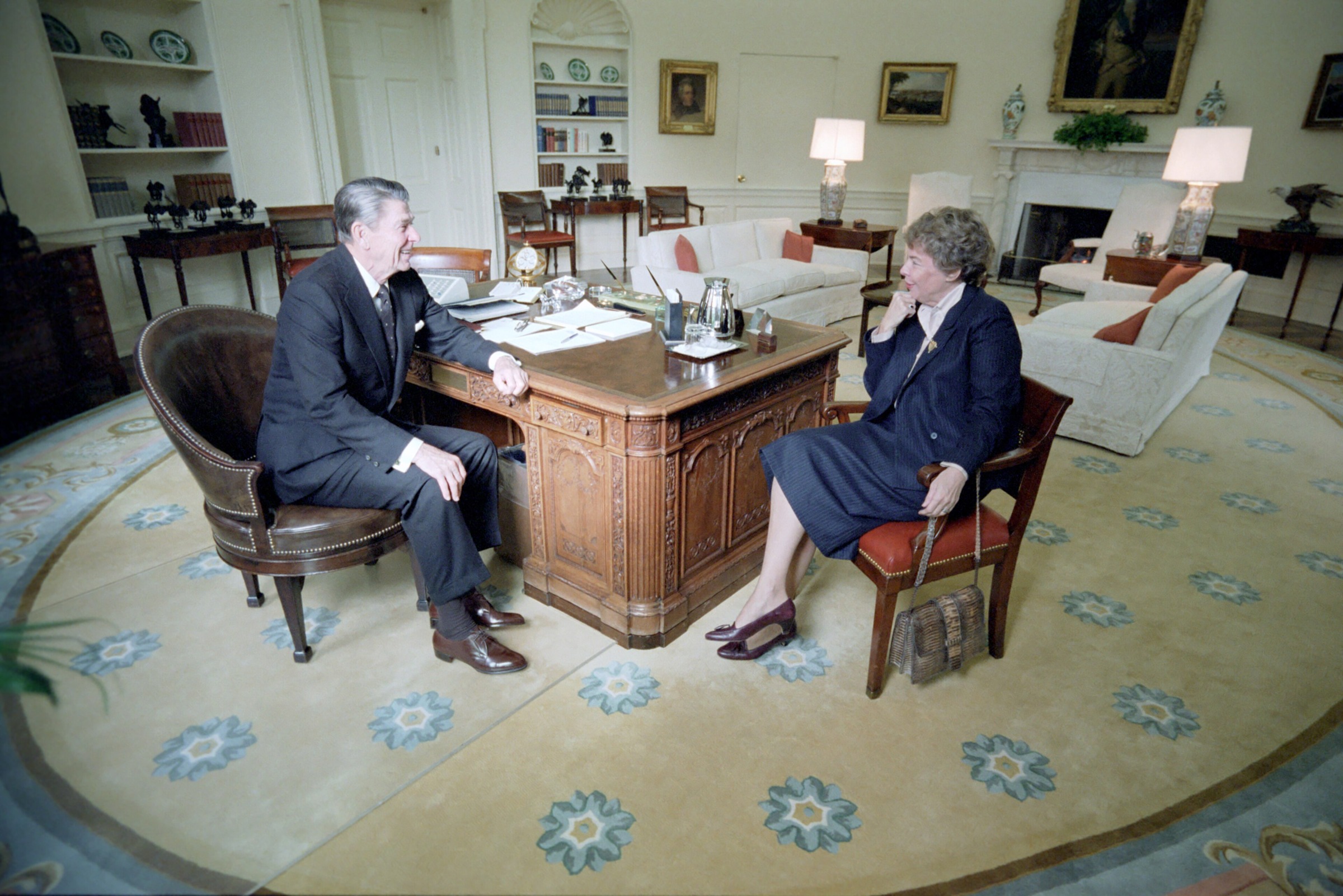
President Ronald Reagan meets UN Ambassador Jeane Kirkpatrick in the Oval Office, November 5, 1982. White House Photographic Office, Ronald Reagan Presidential Library.
Those three built what can be called the postwar conservative settlement. It rested on a few plain ideas. Enemies are real, and a serious country counts them accurately. Strength keeps the peace better than apology does. Allies are assets, to be pushed hard to carry their share but not thrown away. Pressure short of war is the alternative to both appeasement and invasion.
It is not the whole of conservatism, and it never demanded every war. The American Conservative was founded in 2002 by Buchanan, Scott McConnell, and Taki Theodoracopulos to oppose the invasion of Iraq, and much of the country came around to their view. Donald Trump’s record is untidy in the same way. He called Iraq a mistake and NATO obsolete and ran three times against endless wars, and he also killed Qassem Soleimani, struck Iran’s nuclear sites, and seized Nicolás Maduro. Men like Mills quote the candidate and claim the presidency for their doctrine. That is a fair fight to have inside a movement.
The grievance Mills speaks to is also real. Nearly 7,000 American service members died in Iraq and Afghanistan. A young conservative who concludes that he was misled about Iraq has concluded something reasonable. The question is what he is taught to conclude next: that his country chose a bad war and should choose better, or that his country is the problem.
Mills does not hide where he stands on the settlement itself. In February, in an interview the Stimson Center published, he said the modern conservative movement is William F. Buckley Jr.’s invention, a postwar creation that is not real and not especially conservative. Woodrow Wilson and Franklin Roosevelt, he said, in part lied the country into the world wars. Asked whether NATO ever served a purpose, he answered not particularly, unless one needed to fight a Cold War, and of that he said, “I’m less convinced of the necessity of the Cold War.” He called Western civilization a concoction.
Two weeks later, on Ross Douthat’s New York Times podcast, he was asked whether his side meant to change how the American empire works or to retreat and dismantle it. He was “far more” for the second. The critics of the course America took after the Second World War “lost the battle,” he said. “But they were right.” He took a side in the Pentagon meeting of 1951: “I prefer Robert Taft to Eisenhower.” He called Reagan “fundamentally an overrated conservative figure and overrated president,” and he told The Economist in October that “Reagan is the baby-boomer god” and that “if Reagan is their god, then it must be a false god.”
Mills’s defenders say the masthead settles the matter: he is a Buchananite, saying what the Old Right has always said. It is a serious answer. Buchanan opposed the Iraq War and the Gulf War before it, wanted American ground troops out of Europe once the Cold War was over, and questioned the case for America’s entry into the world wars. Mills holds all three positions.
But that is not the whole of it. Buchanan fought the Cold War from inside Nixon’s White House and Reagan’s, and his 1990 case for coming home began from the premise that the war had to be fought and had been won. Mills is “less convinced of the necessity of the Cold War.” Buchanan wrote The Death of the West to defend a civilization he thought was dying. Mills calls Western civilization a concoction. Buchanan’s quarrel with empire was a nationalist’s quarrel; even as he called the troops home he wanted America kept “permanent mistress of the seas, first in air power, first in space.” His book was called A Republic, Not an Empire. The complaint was misuse. Mills’s complaint is the thing itself: an “illegitimate and hated empire.”
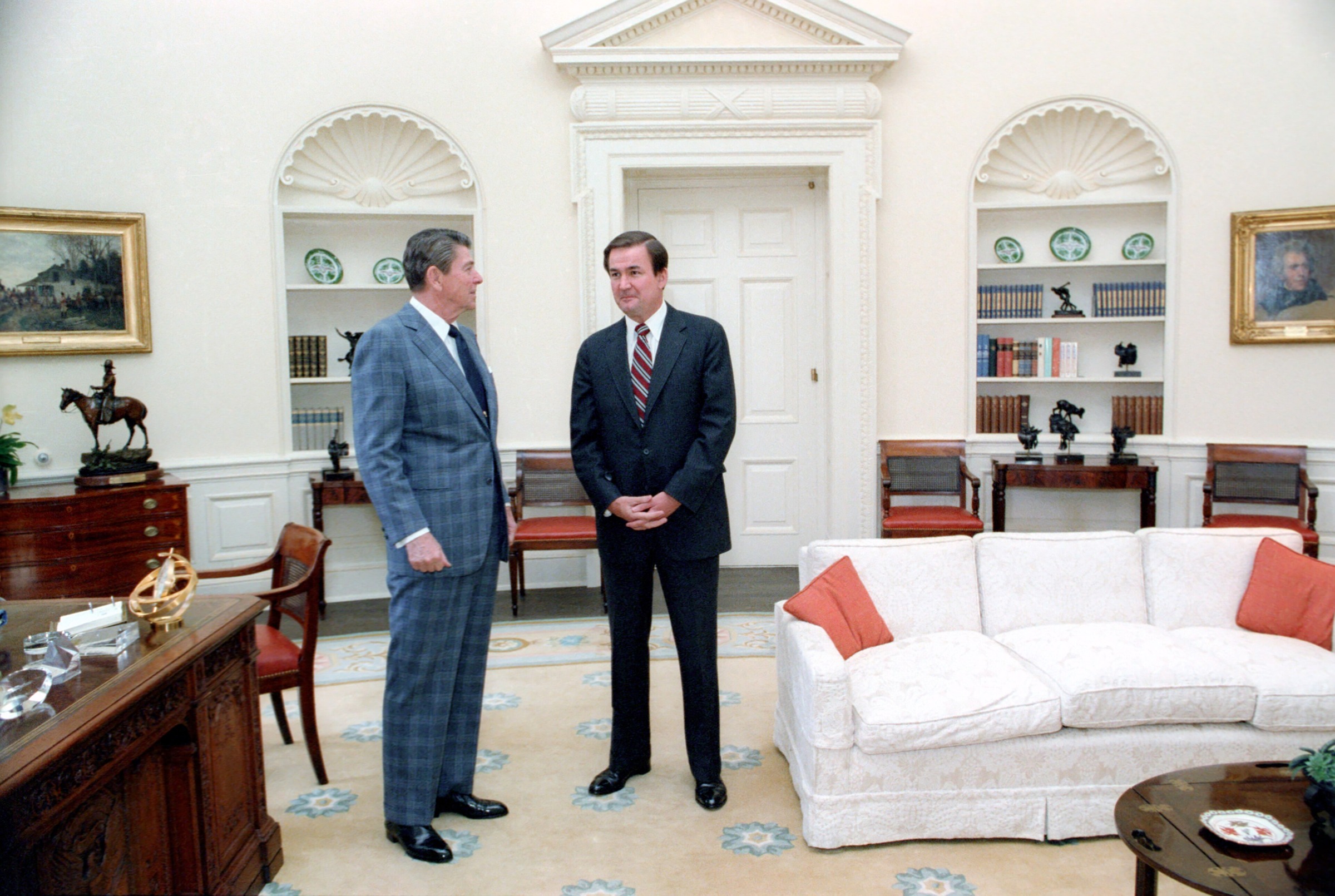
Reagan with Pat Buchanan in the Oval Office, March 19, 1982. Buchanan became White House communications director in 1985. White House Photographic Office, Ronald Reagan Presidential Library.
The Enemy, as He Tells It
The record does not show a man who is against American power everywhere. At Stimson Mills said that the country and its founding institutions are good, that if he is hawkish on anything it is China, and that he is not a total restrainer. But on the fronts where America’s enemies have killed Americans or invaded their neighbors, he assigns the fault to the United States. Where he would use power, as with Greenland, he does not apply the standards he uses elsewhere. And the exception he once made for China has been wearing away.
His March 2020 “lucky shot” post is gone from his account, but the idea is not. The day after the anniversary in 2025 he told Matt Gaetz that Osama bin Laden “was a marginal fringe character in the Muslim world,” “basically the head of a couple of thousand fighters hiding out in caves and deserts.”
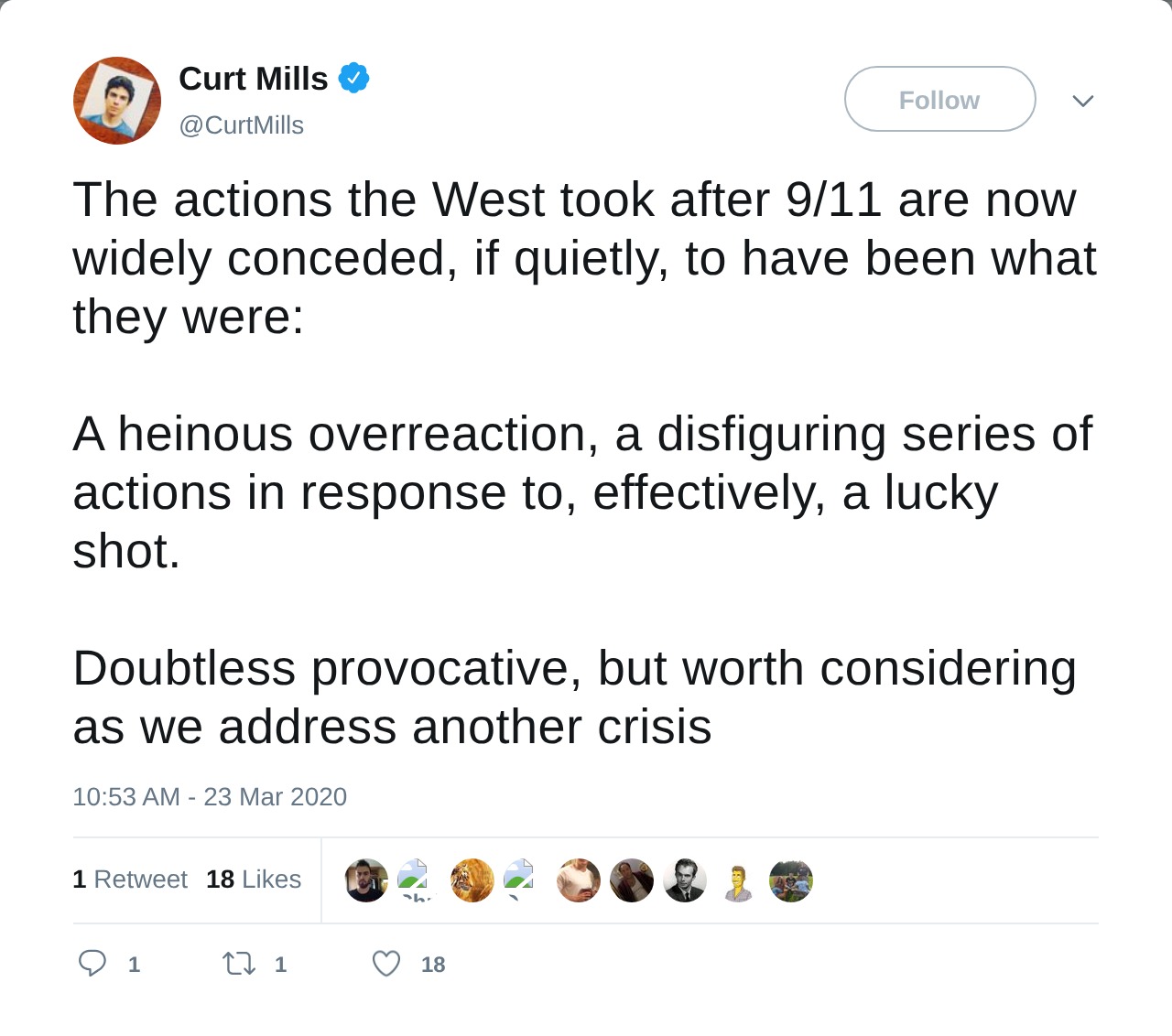
Mills’s post of March 23, 2020, since deleted, as captured by the Internet Archive. Internet Archive Wayback Machine capture of X (Twitter).
There is an argument in this. Al Qaeda in 2001 was small, and the response grew into two wars, one of them against a country that had not attacked the United States. A man can hold that the response was out of proportion to the threat. But Mills’s sentence condemns the response whole. It covers “the actions the West took after 9/11” without exception, and the alternative he has since named is “a counter-terrorism and police action.” That rules out the campaign against al Qaeda’s hosts in Afghanistan, which Congress authorized three days after the towers fell, by 420 to 1 in the House and 98 to 0 in the Senate. What America did instead he calls “an American Holy War against an entire region.” And the enemy he describes is not the one on the record. Al Qaeda had bombed two American embassies in East Africa in 1998 and the USS Cole in 2000, and its leader had twice declared war on the United States in writing.
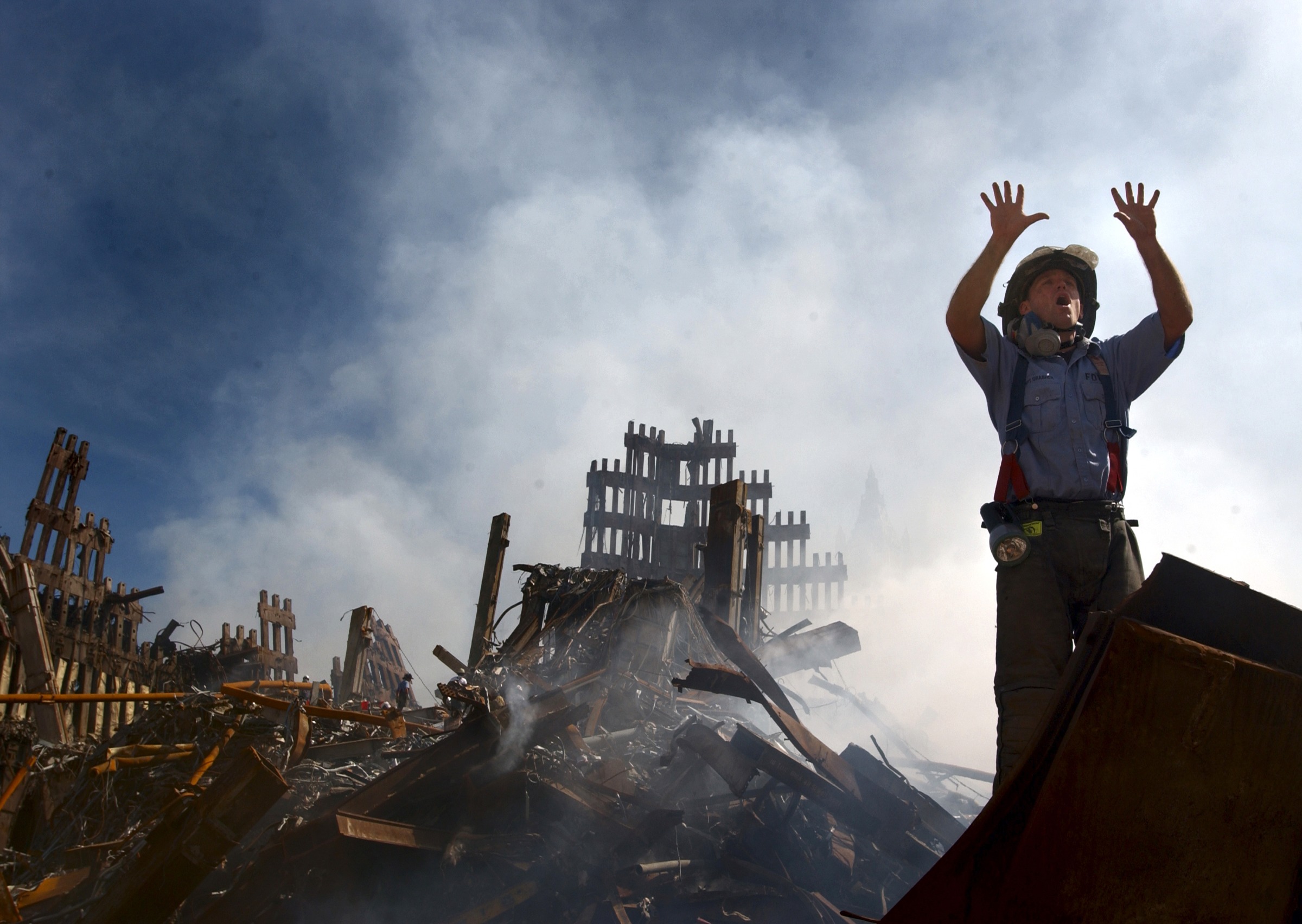
A New York City firefighter calls for more rescue workers at the World Trade Center, September 2001. Journalist 1st Class Preston Keres, U.S. Navy.
He has also made the jihadists America’s own work. At a Washington debate the day after the anniversary in 2024, he cited the Reagan administration’s proxy wars and added: “Again, with blowback, anniversary of nine eleven.” On War Room, in the first week of the Iran war, he put it in a sentence: “America’s problem with terrorism is related to its force posture overseas.”
On Iran there are two records. In Iraq, the Pentagon has assessed, Iran-backed militants killed at least 603 American service members between 2003 and 2011. In April an interviewer put Iran’s record of killing Westerners to Mills. He answered that the Saudis have “more blood on their hands” than anyone, and went on: “I think the Iranians were plucky foes in areas where the United States was occupying countries like Iraq.” He added that the United States “shouldn’t have been occupying countries like Iraq,” and that he did not mean to defend “the deaths of American servicemen.” “Plucky” is not a judgment about the occupation. It is a word of sympathy for the side that was killing Americans.
The other record is the plots on American soil. At Stimson he said the Iranians do not really assassinate people here, described reports of attempts as “very fringe allegations,” and said any such attempts were “downstream of our very adversarial foreign policy towards them.” In 2012 a man pleaded guilty in federal court to conspiring with Iranian military officials to kill the Saudi ambassador at a restaurant in Washington. In March 2025 a federal jury in New York convicted two men of plotting, with Iran’s money, to kill the Iranian-American journalist Masih Alinejad at her home in Brooklyn; they were sentenced to 25 years each. In November 2024 the Justice Department charged a man it called an asset of Iran’s Revolutionary Guards who told the FBI he had been tasked with planning the assassination of Donald Trump; he remains at large in Iran, and two New Yorkers hired to kill Alinejad pleaded guilty and were sentenced this year. None of these plots succeeded, so Mills’s narrow statement stands. His description of the attempts does not.
This July Mills described an intelligence report alleging that Iran was trying to assassinate the president, telling the War Room audience it was “entirely possible” that some Iranians were discussing plots. That, he said, is “kind of part and parcel of going to war with a country,” and “the idea that Iran is this major menacing threat to the United States is completely overstated.” In late October, asked on Glenn Loury’s program about a nuclear-armed Iran, he said it would not be the end of the world but “similar enough to the North Korean situation,” and that Iran was “able to fight the world’s most powerful empire to a standstill and a draw at minimum right now.”
In 1983 a truck bomb killed 241 American servicemen in their barracks in Beirut. They were the Marines of Kirkpatrick’s speech, and the United States attributes the attack to Hezbollah and its patrons in Tehran. This June, on War Room, Mills said Hezbollah was “not a danger to the United States.” “Is Hezbollah full of hard Lebanese dudes? Sure,” he said. “But if the U.S. simply didn’t mess in this region, I don’t think there’s a serious case of blowback.”
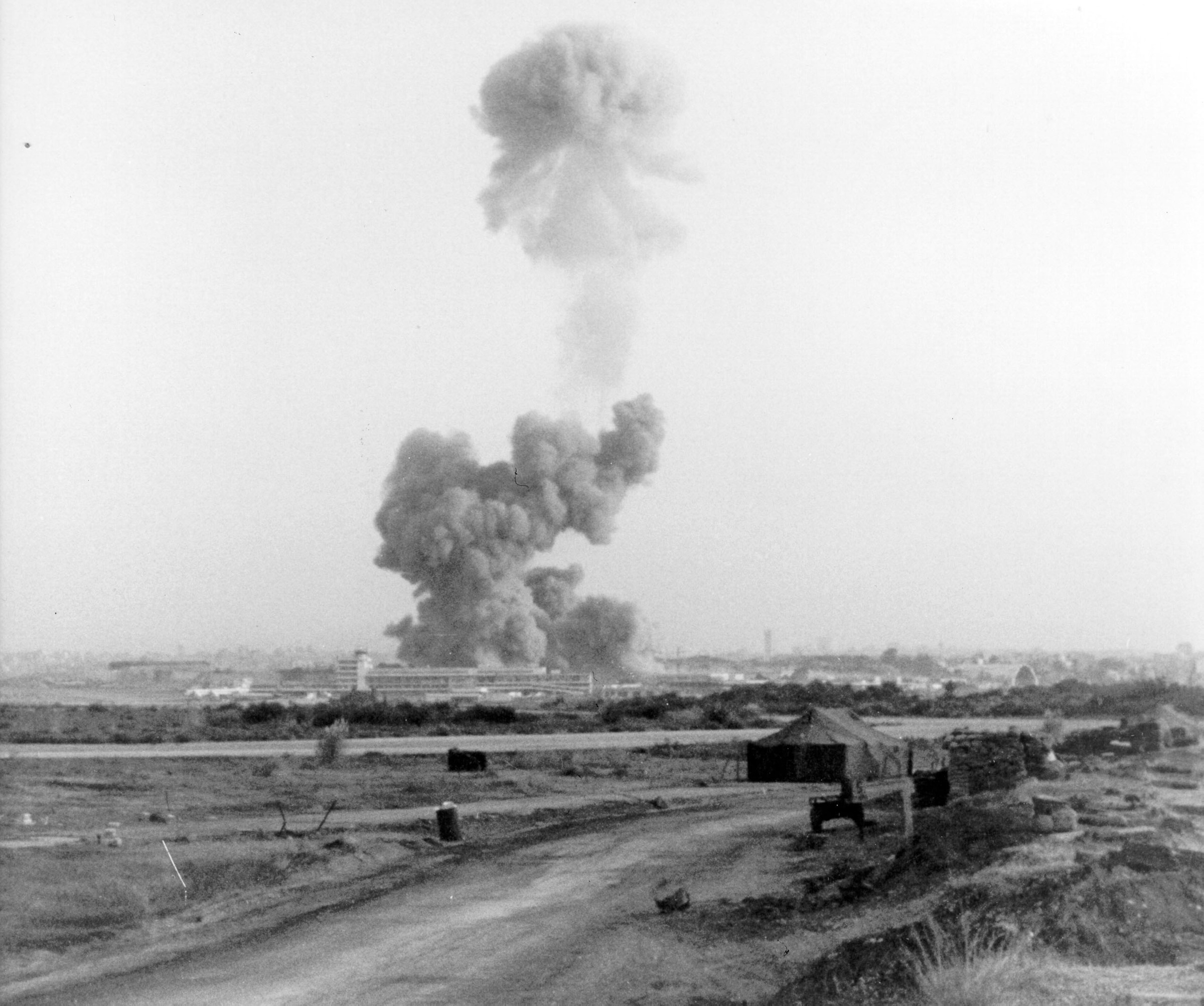
Smoke rises over the Marine barracks in Beirut after the truck bombing of October 23, 1983, which killed 241 American servicemen. U.S. Marine Corps.
On January 24, 2022, he posted his “overwhelming understanding: Putin isn’t really going in.” When it began, his account of the cause was: “Putin did this, ultimately, because he was bored.” At the 2024 debate in Washington, the subject was Ukraine. “We’re not defenders of atrocities,” he said, and then: “Bucha was used, it appears, as a bit of a propaganda ploy to scuttle serious ceasefire negotiations.” The U.N.’s human rights monitors documented the killing of 73 civilians in the town and were corroborating 105 more. Mills claimed “every day new disclosures of that story come out” and named none.
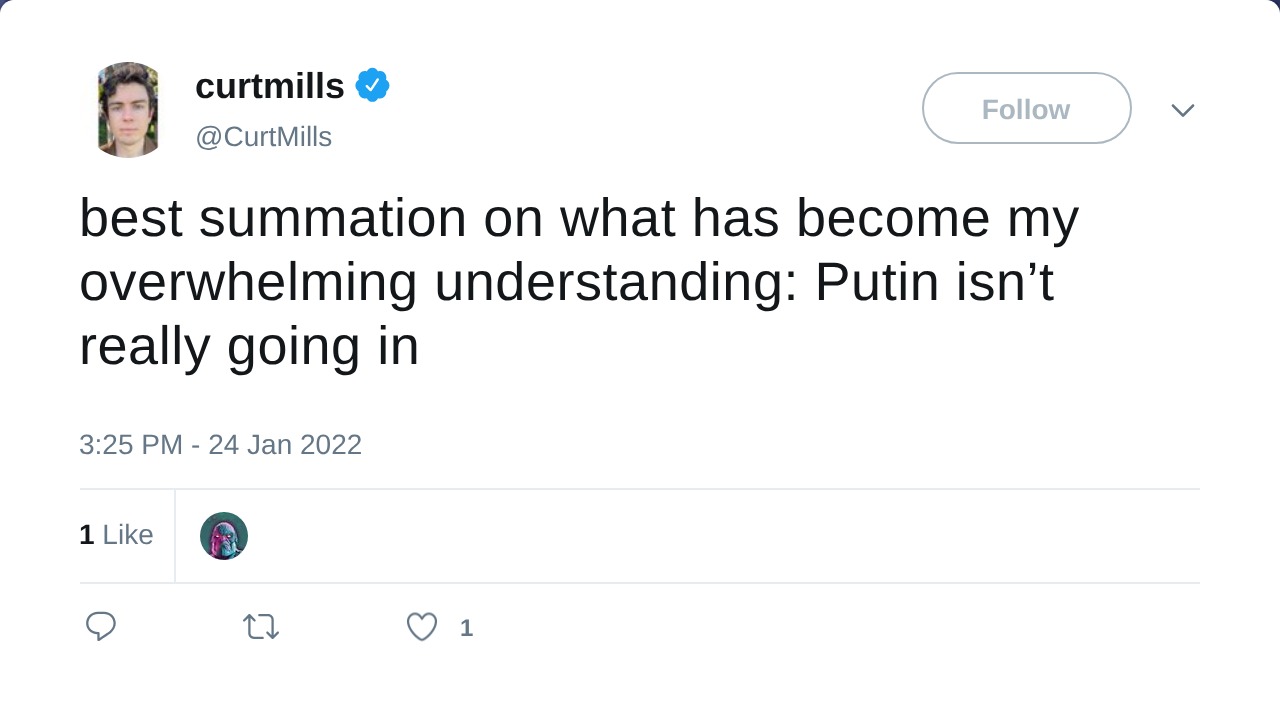
Mills’s post of January 24, 2022, one month before Russia invaded Ukraine, as captured by the Internet Archive. Internet Archive Wayback Machine capture of X (Twitter).

Bucha, April 6, 2022: the summer camp Russian troops used as a headquarters during the occupation. Vitaliy Sarantsev and Roman Drapak, ArmyInform, CC BY 4.0.
Mills would answer much of this with China, and his record there is real. In October 2021 he published an essay in The American Conservative headlined “Taiwan: An Actual ‘Munich Moment’” that called Beijing’s arguments for annexing Taiwan “as frankly spurious as Adolf Hitler’s once were.” But the record also dates the change. By April 2024 he was telling the War Room audience that if Taiwan would not meet its own defense needs, American aid was “merely provocative to the Chinese and invites this invasion sooner.” At Stimson in February he still described himself as hawkish on China, and said strategic ambiguity over Taiwan had worked. He also said that he has moved steadily toward the restraint end of the argument.
The Allies, as He Tells It
“NATO is effectively either an obsolete or freeloading organization, which is my perspective,” Mills said in May 2025. That September he wrote: “All things being equal, I would leave NATO or severely curtail our commitments to it.” This February he added: “Our allies are not key to our survival.” On October 10 he wrote that Americans and Europeans do not and should not have any “binding common purpose,” and that “the 20th century was heresy.” Trump’s approach has been to make the allies pay more; at The Hague in June 2025 they committed to spend 5 percent of GDP on defense by 2035, at least 3.5 percent of it on core military needs. Mills’s aim is to get out, by stages if he can, though he has said that “sometimes it’s better to rip the band-aid off.” When the Senate voted in 2023 to bar any president from quitting NATO without its consent, the tally was 65 to 28.
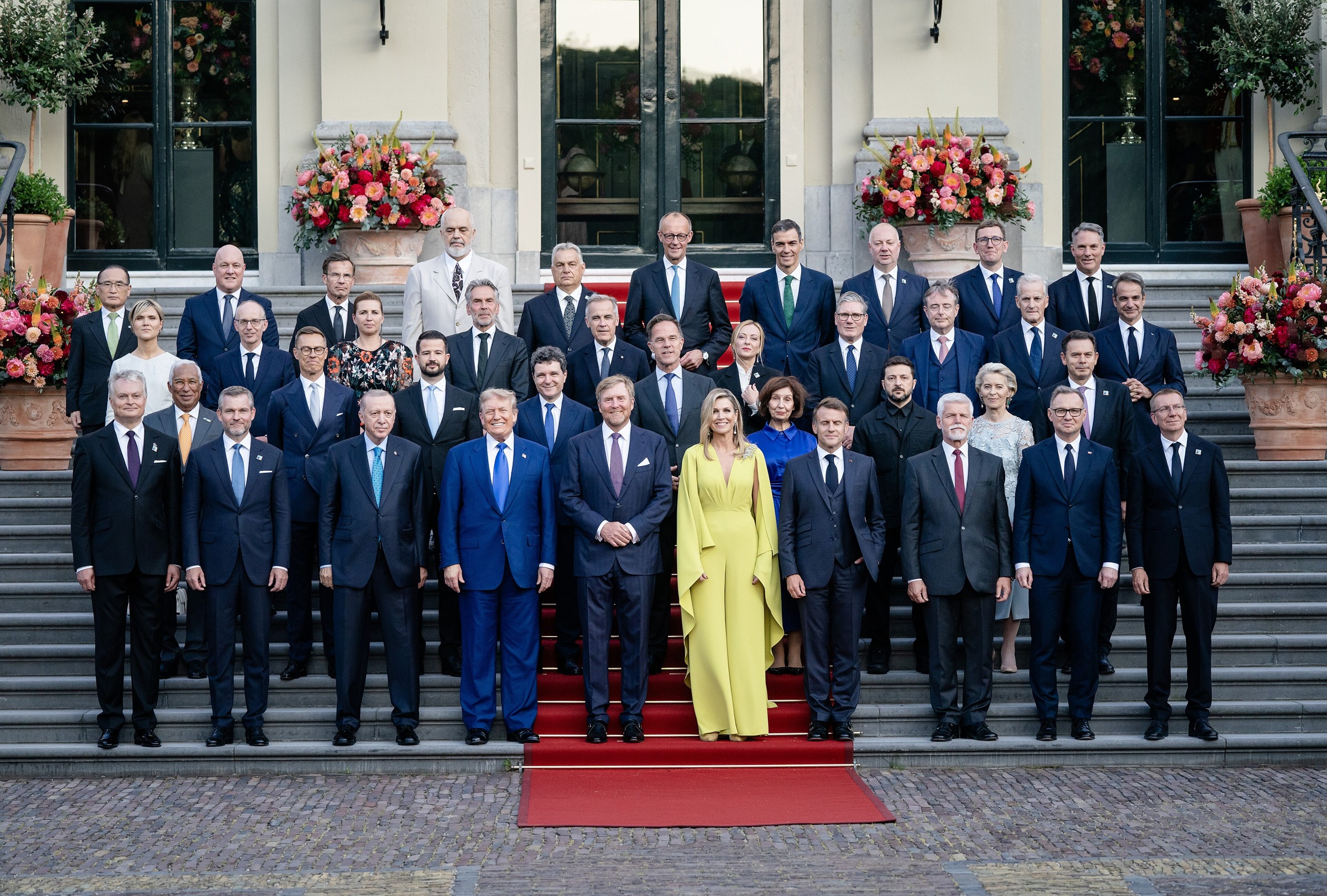
Allied leaders at the NATO summit in The Hague, June 2025, where members committed to spend 5 percent of GDP on defense by 2035. Bart Maat, Netherlands Ministry of Foreign Affairs, CC BY-SA 4.0.
Greenland belongs to Denmark, a NATO ally that lost 44 soldiers in Afghanistan, and it still does: the basing agreement Washington signed with Copenhagen and Nuuk in September adds American bases and leaves Danish sovereignty in place. In a January 2025 poll, 85 percent of Greenlanders said they did not want to become part of the United States. In April, asked about the administration’s talk of taking it, Mills said: “I think that’s the only one. I wish we were doing that.” It might have “spurred a NATO crisis,” he went on. “We might be out of NATO. We wouldn’t be invading Iran.” He doubted it would come to “crossfire between American and Danish troops,” but judged that even that would be “less risky than an Iran war long term.” When the host joked that they had finally found a war Mills would back, he answered: “It’s the smartest war.” On October 22 he wrote that “‘Because it’s big’ remains the best argument for acquiring Greenland,” and credited Trump for reaching for it.
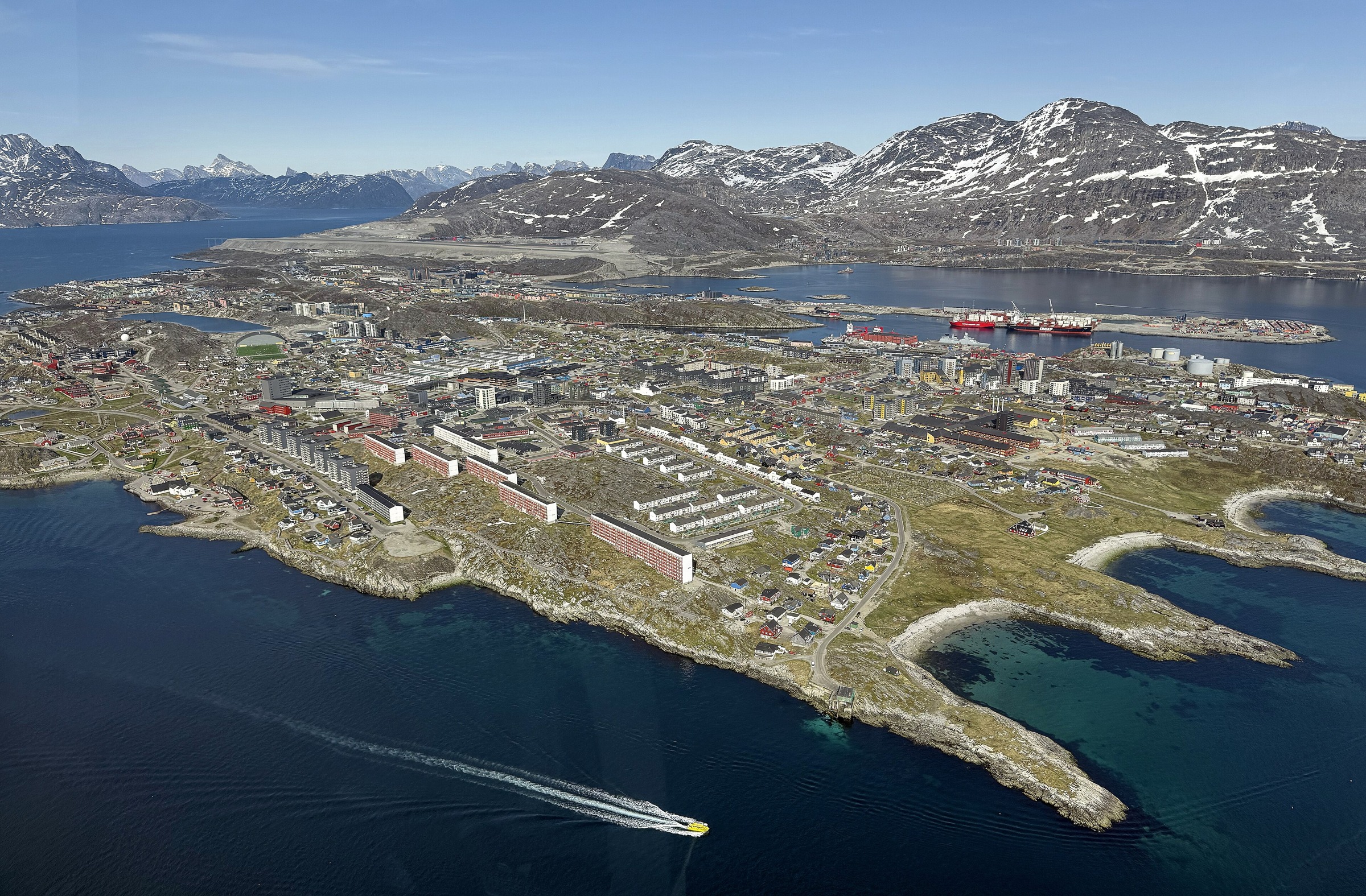
Nuuk, Greenland’s capital, June 2025. Quintin Soloviev, CC BY 4.0.
So what he favors is the annexation of an ally’s territory without the consent of the people who live there, with armed conflict accepted as a risk. He has a theory for it. When Trump began talking of annexing territory in December 2024, Mills welcomed “a return to 19th century-style annexation… republican, not imperial… American, not British.” In the April interview he described Greenland as “basically contiguous to the United States.”
It is not. Canada lies between, and the nearest American state is more than a thousand miles away. His distinction asks whether the people annexed would be given rights; it does not ask whether they consent, and Greenland’s 57,000 people have refused. He calls the Iran war “neo-colonial,” and the Venezuela operation he has placed among the “wars of outright plunder.” “Basically a dominion in the Americas is fine,” he said in a June debate with the lawyer and commentator Will Chamberlain. An unprovoked acquisition of territory from a democratic ally, without the consent of the governed, does not become republican because it is called expansion.
The Theory Underneath
Mills has stated the theory himself. In a New York Times opinion panel in July 2025 he wrote: “A cause of America’s malaise at home is its illegitimate and hated empire abroad.” He has called that empire, “as currently constructed,” “pointless” and “actively counter-productive.” The agenda he told the Post he expects Vice President Vance to carry into 2028, if Vance runs, begins with ending the American empire, and the Post adds that he wants to shut many of America’s bases abroad. The Stimson interviewer put it to him that of his magazine’s three pillars, only opposition to immigration reads as conservative, and that the critique of American empire and of free trade are old positions of the left. “Yeah. I mean, maybe,” he answered.
The account has a history, and it did not begin on the right. In 1959 the historian William Appleman Williams taught the New Left, in The Tragedy of American Diplomacy, to read the Cold War as the work of an American empire in search of markets. In 2000 Chalmers Johnson gave the idea its popular name in Blowback: The Costs and Consequences of American Empire, which argued that the violence done to Americans abroad was the bill for what America had done there. Then came Iraq, which discredited the men who had run the right’s foreign policy, and the account crossed over. At a Republican presidential debate in May 2007, Ron Paul said of September 11 that “they attack us because we’ve been over there.” Rudolph Giuliani asked him to withdraw the remark, and the audience cheered Giuliani. Paul answered with the word itself, blowback, and nine days later gave Giuliani a reading list with Johnson’s book on it. Nineteen years on, the executive director of The American Conservative uses the word for September 11, for Hezbollah, for the killing of Soleimani, and, in October, for Iran’s conduct in the region, which he called “a classic example of blowback” from the 1953 coup. On Know Your Enemy, the podcast sponsored by the left-wing magazine Dissent, he has said it may turn out that “the Reagan-Bush-neocon thing was the aberration.”
He reaches for the left’s vocabulary in other ways. In the June debate with Chamberlain, describing the case made by hawks on his own side, he called it a “Manichaean worldview” of a West that is, “wink, wink, nod, nod, extremely white, against hordes of communist brown people.” He meant his opponents, but the charge, that the right’s idea of national security is at bottom a racial one, is the left’s. He has written that Secretary of War Pete Hegseth has been “burning Venezuelan boatpeople alive” and that Rubio and Hegseth “pursue an arguable murder spree in the Americas.” Of the Iran war he said in a debate in its first week: “I don’t really see what has been achieved other than murder and reveling in the murder.” He has since called it “this asinine and evil war.” This is a vocabulary in which American force is a crime and its officers are criminals.
The Administration, as He Judges It
Mills presents himself as a keeper of the president’s real doctrine. He told the Post in February that the administration “feels like the third term of the George W. Bush presidency,” and yet in an interview the Stimson Center published on February 20 he said “the president of the United States is one of us” and graded the administration a B-minus. Eight days later the Iran war began, and he turned on it. By October 29 he was calling the administration’s first two years “The FDD / Ben Shapiro / Mark Levin / Bari Weiss / Hudson Institute half-term in office.”
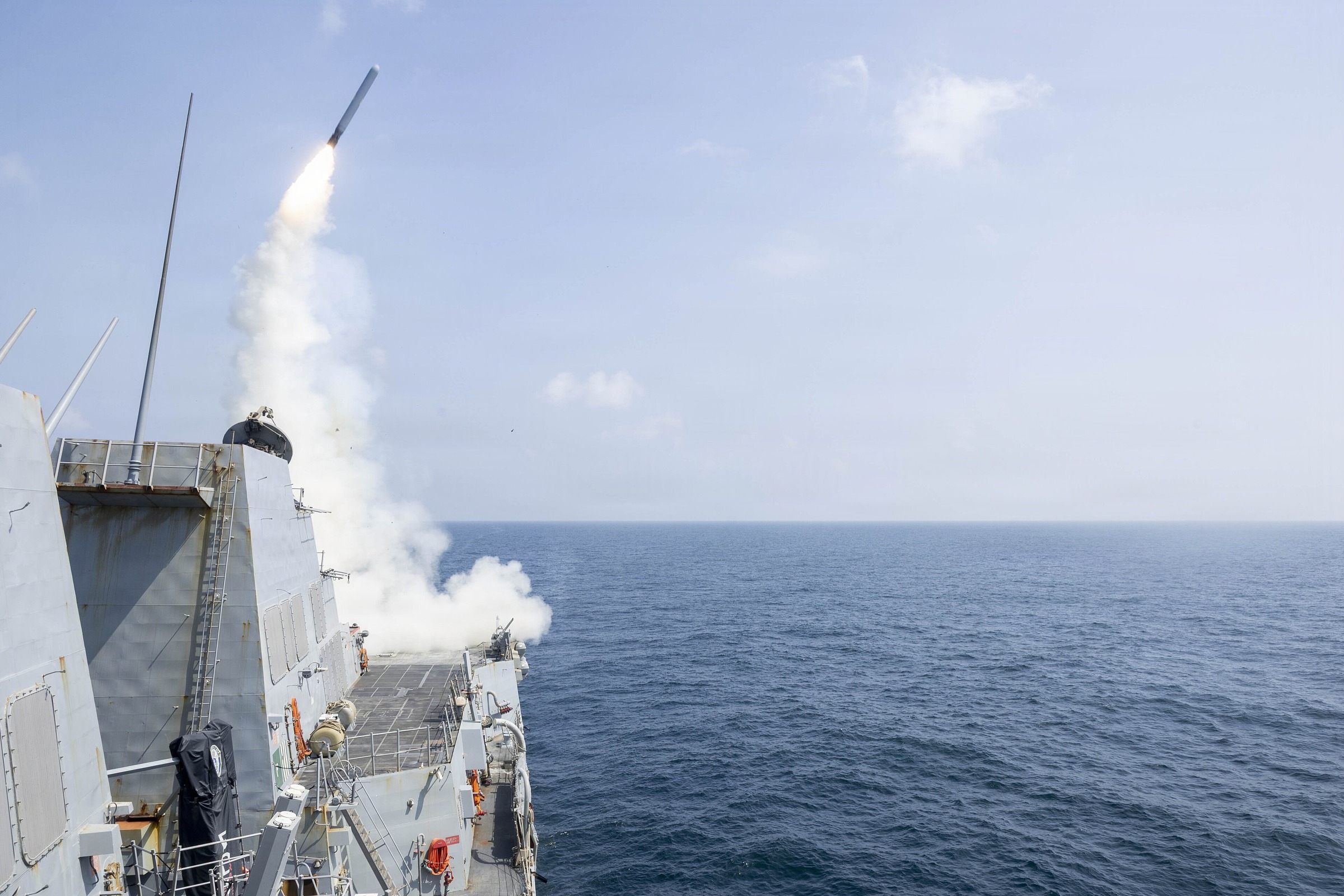
USS Delbert D. Black fires a Tomahawk land attack missile on February 28, 2026, the first day of the Iran war. U.S. Navy.
The test of a doctrine is what its author did. Trump struck Bashar al-Assad twice for using chemical weapons, and Mills says “the Syria strikes in 2017 and 2018 were bad.” Trump killed Soleimani, and Mills, in the same post, recalls that he “denounced the Soleimani slaying live as it happened.” Trump seized Maduro, and Mills called it “the abduction.” Pete Hegseth was “clearly the biggest realist” in March 2025 and “Crystal meth Rumsfeld” a year later. In August 2025 Mills named as “the high watermark of Trump’s second presidency” the president’s meeting with Mohammed bin Salman and Ahmed al-Sharaa, who had led the militia that began as al Qaeda’s branch in Syria. Through it all, Mills, who has opposed nearly every use of force by this president in both terms, is describing his own doctrine and not Trump’s.
For Vance, whom he favors, he has advice. The vice president’s doubts about the Iran war were reported by Politico, and the president has allowed that his deputy was “maybe less enthusiastic” than he was. In March Mills told Ross Douthat that Kamala Harris’s central mistake was “the no daylight policy with Biden,” and that Vance “is going to have to innovate beyond that if he wants to be the president.” On October 30 he told the Telegraph that Vance was still “the leading single individual to be the next president of the United States,” and on November 1 he posted six times promoting a piece in his magazine headlined “J.D. Vance Is the Man to End the War.”
His close ties to Carlson afford him a larger megaphone. Mills has written that Carlson is today what Buchanan was in his heyday, the most powerful columnist in the country, and he said in October that Carlson is “the most important conservative thinker in America, whatever you think of him.” He has called him “probably the leading ‘track two’ contact on foreign policy” with the then-president-elect. What Carlson has done with his megaphone is on the record. He went to Moscow to interview Vladimir Putin and later Sergei Lavrov. Two weeks after the first American strikes on Iran’s nuclear sites, in June 2025, he interviewed Iran’s president, and Mills relayed the opening line as “crystal clear”: “We did not start this war.” In April the president wrote that Carlson, Megyn Kelly, Candace Owens, and Alex Jones were “not ‘MAGA’” and that their views were the “opposite of MAGA.”
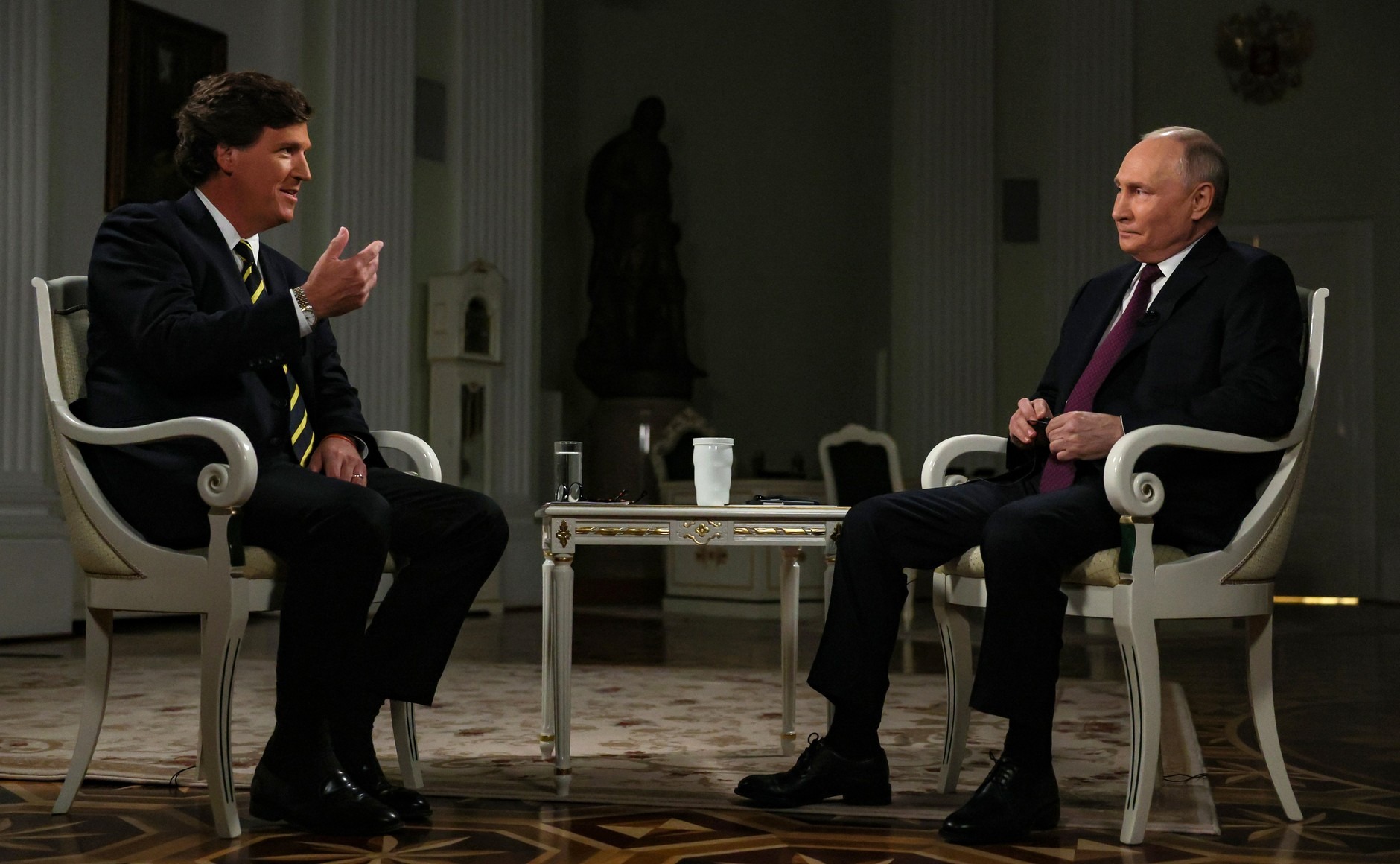
Tucker Carlson interviews Vladimir Putin at the Kremlin, February 6, 2024. Kremlin.ru, CC BY 4.0.
The Co-signer
Mills saw the left-right alliance early and helped build it. The Quincy Institute launched in 2019 with $500,000 apiece from George Soros’s Open Society Foundations and the Charles Koch Foundation; Mills covered its founding under the headline “Realism Resurgent,” and his magazine has since shared stages with it. He carries the argument to the left in person. Under him, he told Jewish Currents, the magazine “reopened to the anti-war left.” In July Jewish Currents reported that the Conference on the Jewish Left, held at Boston University, had booked him for its 2027 meeting as a “potential coalition partner for the Jewish left.” Mills has stated the purpose himself. A “right-left coalition for foreign policy realism and restraint,” he wrote in May, is “one of the most promising trends in American politics.”
The coalition has limits. The Jewish Currents reporter found kinship on foreign policy and “an unbridgeable gulf” on immigration. The Boston invitation was withdrawn within two weeks, after objections from inside the conference. Some on the left want none of it: in October a writer for the left-wing site The Battleground complained that by courting figures like Mills, “once out-of-bounds right-wing thought has found a way into progressive discourse.”
That complaint is well founded. The Democratic Socialists of America say they passed 120,000 members this summer, up from about 50,000 in late 2024. On foreign policy the gap between the DSA and the editor of Buchanan’s magazine is narrow, and Mills is one of the reasons it is narrow. He did not move the socialists; he moved a conservative magazine toward them and has spent years recruiting them as partners. The DSA’s International Committee said “No to NATO” in 2021, and the organization reaffirmed its call for American withdrawal two days after Russia invaded Ukraine; Mills would leave the alliance or sharply curtail it. The DSA’s 2026 program says: “Defund the Department of War. End all foreign wars and close overseas military bases”; Mills, by the Post’s account, wants many of the bases closed. The program calls for an end to “economic warfare” against Iran; Mills told Stimson that sanctions relief and trade would do more than force.
The differences are also real. The DSA’s 2022 statement condemned Russia’s invasion and called for Russian forces to withdraw. The DSA would defund the Pentagon outright and abolish ICE. Mills is hawkish on China, wants Greenland, and wants far fewer immigrants. He is no socialist.
A co-signer does not borrow the money, but puts his name beside the borrower’s so the bank will lend. The socialist left has held these views on NATO, bases, and Iran for years, and they were treated as the fringe. A conservative editor saying the same things to the president’s own voters changes how the views can be presented, to conservatives and to everyone else. When Mills said on War Room on March 1 that the Iran war “looks like an open betrayal of the base,” one headline read: “Bannon’s War Room turns on Trump over Iran: ‘Looks like an open betrayal of the base.’” The words were not Steve Bannon’s. They were a guest’s, and the guest posted the headline himself that night.
He works in the other direction too. Beyond that July 2025 post, he has called Mamdani “a statist but not visibly insane” and, later, “talented.” The post that called him a statist also faulted his “atrocious embrace of 2020 politics.” In the June debate with Chamberlain he went further. If Republicans nominated “Cruz or Rubio or something like that” and Democrats put up a candidate “speaking plain English,” he said, “yeah, I would consider it.” He has a Democrat in mind: he said earlier this year of Representative Ro Khanna of California, “He’s the only one I could imagine supporting,” and a column in The Hill on October 30 listed Mills and the DSA together as constituencies Khanna might win over in 2028. On the Telegraph podcast he singled out another Democrat, Abdul El-Sayed, who won Michigan’s Senate seat on Tuesday, for offering “a sort of left wing nationalism and sort of left wing America first,” and called it “interesting.” He had shared an El-Sayed clip attacking the war on October 9 with the words “Gifting nationalism to the left.”
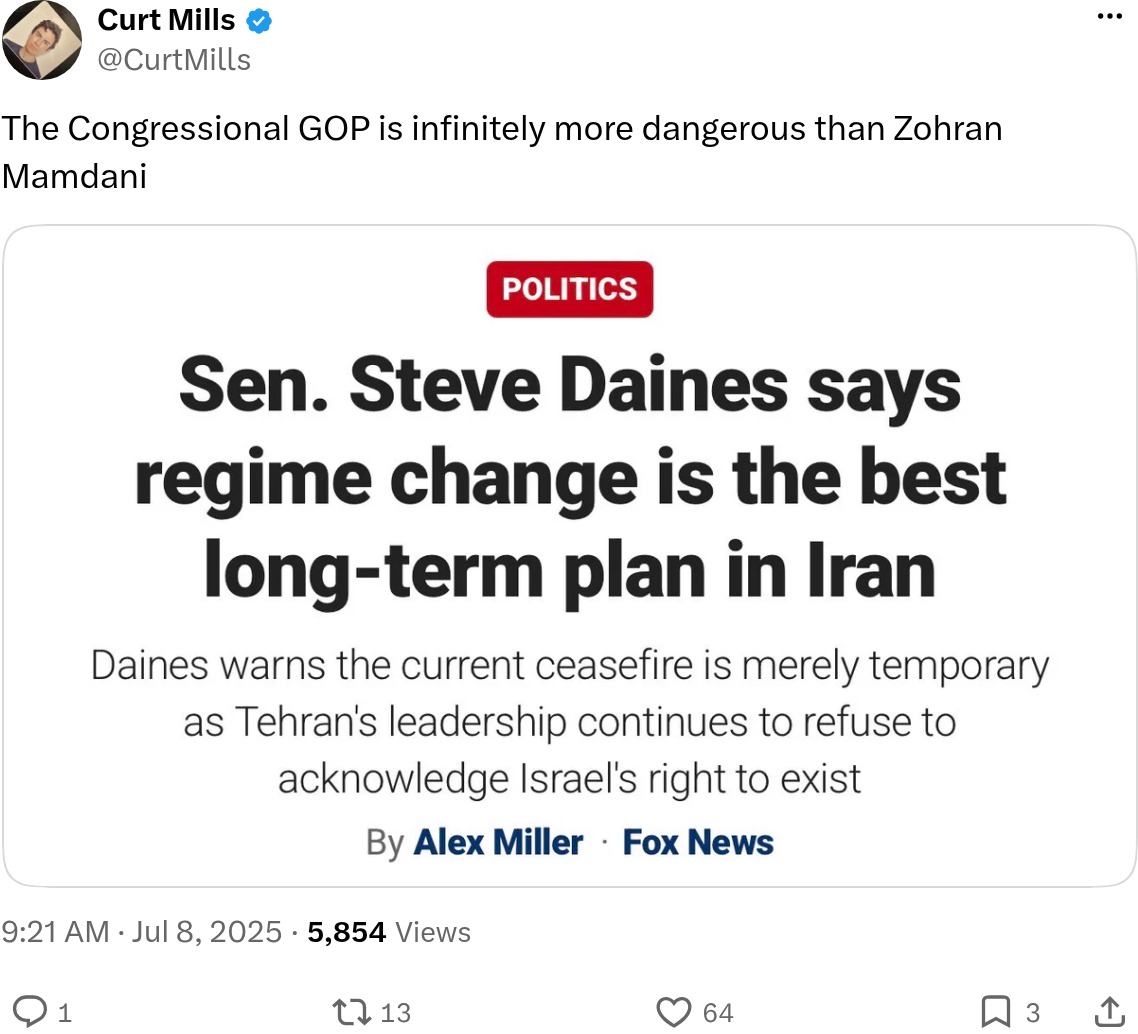
Mills’s post of July 8, 2025, two weeks after Zohran Mamdani won New York’s Democratic mayoral primary. Screenshot, X.
The Test
So here is a test for Mills and his defenders, stated plainly so that it can be proven false. The charge is not that he opposed the Iran war, or the one in Iraq. The charge fails if the record shows him blaming Tehran, Moscow, or the jihadists the way he blames the United States. Since the war began he has called it evil at least five times, most recently on October 22, when he called reported plans for renewed strikes after the election “radical evil,” and before it began he had called “the Iran War advocates” “actually evil.” The archive shows him calling Putin “a talented gangster” and the war in Ukraine “a war of conquest.” It does not show him calling Tehran, or that invasion, evil. In October he answered a Fox host who called Putin “the modern Hitler of our generation” with “Banger, man,” and he dismissed as “Most bog standard answer ever” a call to “stop Putin in Ukraine” from James Talarico, who on Tuesday became the first Democrat elected to the Senate from Texas since 1988.
Asked by Ali that night what would end the forever wars, Mills said the answer was already in the Constitution: “The Senate [sic] should declare war.” That is the old argument about means, and no conservative need quarrel with it. The record beside it is the other argument, and conservatives who book him are entitled to tell the two apart.
A movement can argue about where to fight. It cannot long afford to be told, from inside, that the men who attacked it got lucky.


